The world seems to be changing at an increasingly rapid pace as we accelerate further into the future. Just a few years ago, no one had heard of ChatGPT, Google’s results page looked very different, and artificial intelligence sounded like a sci-fi film. Now, AI is a word on everyone’s lips, and nowhere more so than in company boardrooms and marketing meetings. But why? Well, as dramatic as it sounds, AI has already changed the face of Search – and all because of a little thing called generative engine optimisation.
GEO, as it’s often shortened, is the process of harnessing the quirks of AI to be cited, mentioned and recommended by large language models (LLMs) and AI search. It’s the reason that you may have noticed a drop in traffic to your website; why you’re ranking lower in the SERPs. But, not to worry, generative engine optimisation can help you claw back your online relevance.
Enter this guide from beefound.agency. Here, we’ll explain exactly how SMEs can exploit this valuable tool and why GEO’s major disruption to the internet as we know it mustn’t be ignored.
Skip to:
- What is Generative Engine Optimisation (GEO)?
- Why is generative engine optimisation such a big deal?
- Lifting the lid on how it works
- Beginner-friendly GEO strategies
- The future of AI optimisation and search engines
What is Generative Engine Optimisation (GEO)?
Generative engine optimisation is the new kid on the block for digital marketers and SEO professionals. Like its predecessor, SEO, the objective is to help businesses improve their online visibility and rank higher; the key difference, though, is that this visibility is targeted at AI-generated results, such as Google’s AI Overviews and AI Mode, not to mention large language models, which are increasingly being used by your potential customers.
By optimising your digital presence, from website content to what other people say about you online (think reviews), you can snag AI citations from a whole host of sources outside of search engines. Gemini, Perplexity, Copilot, Llama… the list goes on.
The GEO process is all about creating and structuring your content so that it satisfies both the demands of people and AI models. This way, you can ensure that AI-driven search engines and chatbots discover and parse your output, which allows you to be featured within AI-generated summaries and answers whenever someone writes a relevant prompt. It’s a win-win for brand authority and awareness – a fail-safe recipe for boosting online sales.
Comparing it to traditional SEO
If you’re already fluent in SEO, generative engine optimisation will feel somewhat familiar – but don’t be fooled. While both disciplines aim to increase online visibility, and do so by satisfying audience queries with high-quality, relevant, well-organised content, they cater to fundamentally different ecosystems. SEO is all tied up with ranking; the foundation of GEO is building trust with AI models to get cited.
Here’s the complete run-down to illustrate how they compare and contrast.
SEO versus GEO: What’s the real difference?

| Traditional SEO | Generative Engine Optimisation (GEO) | |
| Primary target | Human-facing search engines (e.g., Google, Bing, Ecosia, Duck Duck Go) | Generative AI platforms and answer engines (e.g., ChatGPT, Gemini, Perplexity) |
| Visibility goals | Ranking in the organic SERPs (those 10 blue links) | Being cited, recommended or paraphrased in AI-generated answers |
| Response type | The list of links, snippets and Google Map listings | AI Overviews, AI search summaries, synthesised LLM responses and citations |
| Keyword implementation | Using the correct keyword placement for ranking organically | Aiming for semantic clarity and contextual coverage for AI parsing |
| Content structure | Focused on meta tags, headings, readability and internal linking | Designed for machine parsing (including FAQs, TLDRs, structured data, etc.) |
| User intent | Matches keywords to queries and serves up relevant content | Interprets deeper intent via AI understanding and |
| Information handling | Optimises individual pages, whose authority signals pass to each other when linked | Influences how AI integrates info from multiple sources |
| Performance metrics | Keyword rankings, impressions, CTR, bounce rate | Citations in AI answers, AI-driven referral traffic |
| Authority signals | E-E-A-T, backlinks, domain authority, content quality, dwell rate etc. | E-E-A-T plus presence on high-trust sources cited by AI |
| Technical requirements | Mobile-friendliness, speed, crawlability, website structure | Crawlability, machine-learnable clarity & structure |
Can they work together?
This is kind of a trick question. If you’re doing good GEO, you’ll automatically be implementing solid SEO strategies. That’s because generative engine optimisation doesn’t replace SEO; instead, it builds on those foundations, and you can think of its principles as more like smart add-ons that help you go the extra mile. That is, helping you exploit more digital touchpoints that are increasingly appearing in ‘the messy middle’ of consumer journeys.
And here’s the kicker: since search engines themselves are moving toward an AI-first future, you might as well start combining strategies now. Even if you’re focused on SEO today, you’ll inevitably need to adopt GEO principles to stay visible tomorrow.
Why is generative engine optimisation such a big deal?
So, what’s all the fuss about? Good question.
The important thing to grasp, irregardless of the hype, is that AI search isn’t a trend; it’s the direction all major platforms are heading in. As of March 2025, 13.14% of all Google queries generated an AI Overview, signalling a trend away from traditional SEO.
But that’s only the tip of the iceberg: you may have already heard that search volume is already leaking away from Google to tools like ChatGPT, Perplexity and Gemini; or, on the flipside, that website traffic is increasingly coming from these sources. In fact, SEMrush expects AI search visitors to surpass traditional search visitors by 2028!
Unsurprising when you consider that ChatGPT alone now handles a billion+ queries every day, and OpenAI is reportedly building an AI-first browser to bring its assistant even closer to the search experience.
In a few words: the bar has been raised.
So, do I need to get on the GEO train?
Yes, absolutely. If you actually want to ‘bee’ found and grow your business online, you’ve got to stay relevant. Nowhere is this more pressing than in competitive markets like SaaS or e-commerce, where early movers are already moulding their practices, and tech, to the shift.
Most businesses aren’t thinking about AI visibility yet, but when they do, it’ll be too late to claim the easy wins. Starting now gives you a real chance to build stronger, more frequent AI citations before the space gets crowded, and – sorry to say it – that’s going to matter when your competitors suddenly appear in AI answers, and you don’t.
Lifting the lid on how Generative Engine Optimisation (GEO) works
First and foremost, generative engine optimisation is about aligning your digital presence with the data inputs that feed large language models and AI-powered search engines in the first place. Put simply: if you want AI to recommend your business, you need to appear in the right places, in the right formats, with the right signals.
Here’s an example to illustrate our point:
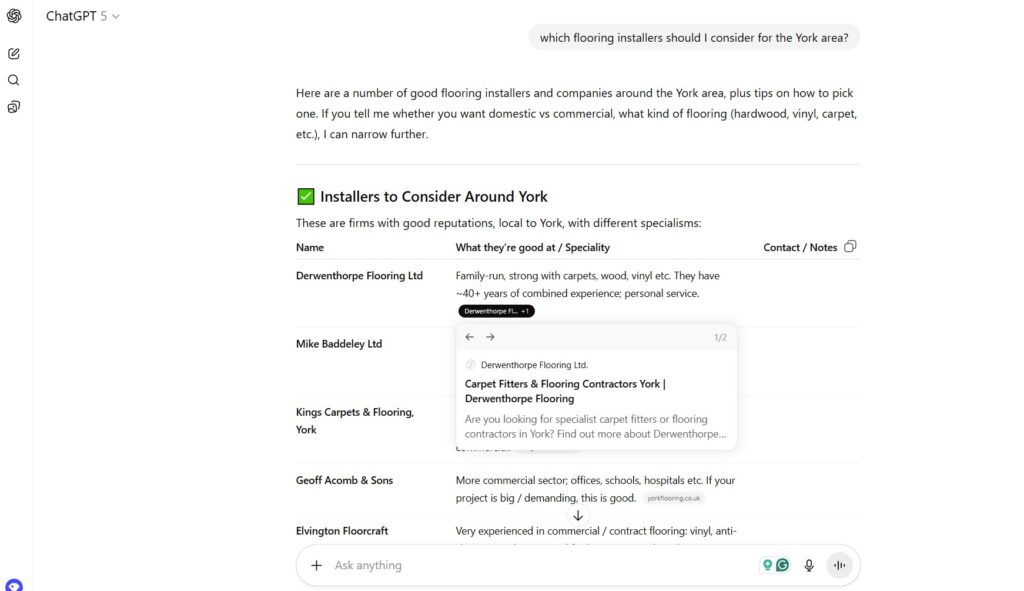
Here, we asked ChatGPT, “Which flooring installers should I consider for the York area?”. As you can see, to produce this handy recommendation list, the LLM has run a web search in the background, pulling from numerous sources.
The first entry is our client. Now, you might be wondering how we got them to this top position…
AI favours high-quality, easy-to-crawl content
To an outsider, generative engines are baffling, magic even. But if you open up the bonnet, you’ll see that they’re anything but mystical. They work by scouring the internet for relevant, high-authority, high-clarity content related to a given prompt, and synthesising what they find into readable summaries filled with citations.
By ensuring that your content is visible and understandable to AI, you increase the likelihood of it being your content that is crawled and recommended. Returning to our flooring fitters example, we ensured the following things for our client:
- Their web pages were crawlable and indexable by improving their website structure and markup
- Their business copywriting was done to a high standard that favours both people, search engines and AI – for example, publishing content in formats AI crawlers prefer like FAQs, explainers, how-tos and comparison guides.
- They were building a broad, comprehensive backlink profile
- Their Google Business Profile was optimised to reap the rewards of Google and aggregated third-party reviews
Rank in generative engines’ underlying web searches
What many don’t realise is that AI models often run a web search in the background to source the most relevant, trustworthy content before generating their response. So, if your content isn’t showing up in the underlying web results, you’re already at a disadvantage. Hence, why you shouldn’t ditch your current SEO efforts.
Think back to our flooring fitters example. When we prompted ChatGPT with our query, the model didn’t just pull names out of thin air. It scoured real-time web results and prioritised businesses whose websites were:
- Again, indexed and crawlable
- Rich in local signals (location pages, reviews, Google Business listings)
- Showing clear semantic signals beyond keywords, so a deep contextual coverage of topics
- Demonstrating topical authority through internal linking and comprehensive topic clusters
- Providing signals of recency and relevance through regular blogging and Google Business Profile updates
It centres citation, not ranking (AKA reputation matters)
As we know, traditional SEO is about climbing the ranks, but GEO, on the other hand, is about being trustworthy enough to be cited. When LLMs generate answers, they synthesise content and credit sources they perceive as reputable, which means your brand needs to be seen as both credible and citable, as well as optimised.
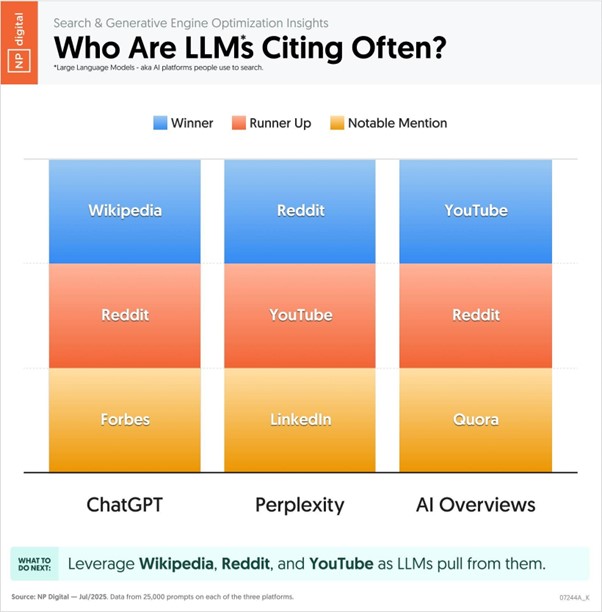
Case and point: this recent study by Neil Patel’s team, which analysed over 25,000 prompts across ChatGPT, Perplexity, and Google AI Overviews to reveal a clear pattern:
- AI engines tend to pull from the same predictable set of sources,
- And intriguingly, Reddit was the only constant across all three platforms, while YouTube, Wikipedia and media sites dominated depending on the tool.
So, what does that mean for you? Well, put simply, online reputation now directly impacts your visibility in AI-driven search. And as we explored in our recent blog on reputation management, it’s much more than publishing a few PR articles. You’ll have to think about…
- Earning third-party citations on trusted sites through targeted outreach (local directories, trade media, editorial links, social media collabs)
- Getting mentioned organically in forums and community platforms (like Reddit or Quora)
- Maintaining a robust presence on Google Business with recent, high-quality reviews
- Publishing helpful, structured content in AI-parsable formats (think FAQs, how-tos, comparisons)
- Leveraging multimedia (e.g., YouTube videos and SEO-optimised podcasts), which are now increasingly cited in AI summaries

Beginner-friendly Generative Engine Optimisation strategies
At this point, you’re probably wondering – how do I get my business, my products, my services recommended by AI models? Here are some solid generative engine optimisation strategies that don’t require you to overhaul your entire site.
1. Reverse engineer AI Overviews
A good way to begin understanding what sort of content gets cited by LLMs is to look at Google’s AI Overviews for your target queries. Analyse which pages are being pulled in, what formats they use, and the information that’s deemed relevant. You’ll notice that structured, high-authority content always stands out.
2. Structure your content for AI consumption
As a rule of thumb, generative models prefer clarity over cleverness, and this extends from the language and syntax you use to the overall structure of the content. Use formats like TLDRs, FAQs, how-tos and comparison tables to keep things parsable, and don’t forget to make your wording natural and aligned with how people phrase questions in tools like ChatGPT. It’s all about balancing the needs of readers and algorithms.
3. Build out content clusters & focus on E-E-A-T
AI models assess your topic coverage as well as individual pages. Publishing multiple related articles and stitching them together with a network of considered internal links helps signal authority and relevance at the same time as bolstering your crawlability.
Here, you should also focus on experience, expertise, authority and trustworthiness – demonstrating across your whole digital presence – to get in the good books of search engines and AI models. This will help you on two fronts: improving the depth and quality of the content, thereby improving brand awareness, and also enhancing your visibility online.
Additional reading: To track what’s working and what isn’t, our website visitor tracking guide has plenty of pointers, and when you’re done there, learn how to avoid thin, low-value content with our article on AI content ranking myths.
4. Build visibility beyond your website
We covered the importance of reviews, organic brand mentions and link-building, but how do you get them? Start by identifying the websites, forums, or industry blogs already cited in AI Overviews for your niche; these are the voices LLMs are listening to. Reach out with genuinely helpful content, unique data or expert commentary that demonstrates a solid value proposition.
Meanwhile, give people reasons to talk about your brand organically. You could share insights on Reddit, answer questions in niche communities, publish shareable explainers and put in the extra effort to make your content easy to quote. If people mention you unprompted, that’s exactly the kind of trust signal AI engines are more likely to surface and cite.
5. Leverage AI, but don’t over-do it
AI is a great tool for efficiency and quality control, but it’s best not to solely rely on it for content creation. Data analysis, a sounding board and topic research are perhaps the most effective uses. That said, there are also plenty of powerful AI-powered SEO tools (besides ChatGPT) that are already implementing features to help brands appear in both the SERPS and LLMs – we’ve already written a guide featuring our top picks, so go check that out!
Where we’re headed: The future of AI optimisation and search engines
Speculation about LLMs and AI search is rife in our industry, but it’s not all hot air. There’s actually plenty of evidence to suggest that these systems might one day replace traditional search engines entirely, and the most interesting part is that we’re not heading towards one standard, but instead a mix that each change how people find information in unique ways.
According to SEMrush, even when a page is featured in AI Overviews, it often doesn’t get the clicks you’d expect, meaning that gold-star visibility no longer guarantees engagement anymore, especially when answers are being delivered in full by the search engine itself.
At the same time, platforms like ChatGPT and Perplexity are shifting user habits even further as audiences go directly to LLMs to ask for advice, recommendations and insights, completely bypassing the SERPs. The theory that has caused the most ‘buzz’, however, is the implication that generative AI engines with ads might be on the horizon, which completely changes the rules of the game. In any case, familiarising these models with your brand is a must.
Get ready to rank, convert and scale with generative engine optimisation
And there we have it: your primer on generative engine optimisation. From understanding how generative engines work to applying practical, beginner-friendly strategies, you’re now equipped to take your first steps into AI-era optimisation.
At the end of the day, generative models are pattern-recognition machines. They analyse enormous datasets to predict what information best fits a query – a complex statistical calculation, if you will. This means there’s great potential in influencing what they’re fed.
In other words, if you want to be part of the output, you need to become part of the input. And that involves implementing the strategies we shared above.
Ready to put GEO into action, but still not sure how to go about it? Try our all-done-for-you AI SEO service PromptRank, to earn AI-trusted citations and build the visibility required to thrive in today’s changing world.