Robots are on their way…wait, never mind, they’ve already arrived! Yep, that’s right robots – and chatbots specifically – are here to stay. In the few months after ChatGPT was released in 2022, it’s fair to say that they’ve taken over. From students relying on AI to do their homework to marketing buffs using ChatGPT SEO to refine their campaigns, there are so many applications.
In this elaborative article, we’re going to lay bare the ways you can and can’t use AI for SEO, including the best techniques for using ChatGPT for keyword research and 6 pitfalls to avoid.
Skip to
Where did ChatGPT come from?
For the uninitiated, who might be scratching their heads, wondering “What is Chat GPT?” – have you been living under a rock? And what’s the secret to remaining sheltered from the digital age?
Jokes aside, let’s hear the answer from the AI’s own ‘mouth’.

So, put simply, Chat GPT is a generative language model powered by machine learning; you feed in information from the internet on one side and out comes a set of natural language responses. Able to engage in text-based conversations, this AI has a number of uses from answering questions posed to it to generating a whole host of creative content from code to blog copy.
Sounds useful, right? Exactly.
Since it was launched in November 2022, Chat GPT has taken the digital world by storm, smashing through record after record. For one, it’s won the title of the fastest-growing user base in consumer application history, with 100 million monthly active users braving the AI landscape just 2 months after its release.
This goes to show that the years of development and data training that went into building Chat GPT have paid off infinitely.
ChatGPT and SEO: Is it a good idea?
The energy poured into Chat GPT has paid dividends for the developers, but what about its users?
First off, we’d never – and we mean never – encourage budding marketers and business owners to rely solely on generative AI to ‘do their SEO homework’. Google’s algorithm explicitly states that while the “appropriate use of AI or automation” isn’t penalised, low-quality and unhelpful content will be. And this is where it gets tricky.
Chat GPT is just one facet of the growing capabilities of AI, and like all other AI models trained by humans, it’s fallible. Meaning that mistakes, inaccuracies and poor-quality control are all problems. This isn’t to say that automation is the bad guy, rather, it should be viewed neutrally with a healthy dose of critical thinking and scrutiny.
In fact, Google also mentions in its guidelines that content is content, AI-generated or not. So what really matters is getting your content marketing game up to scratch. Translation: you need to make sure all content satisfies each of the following.
It should be…
-
- Engaging
-
- Trustworthy
-
- Authoritative
-
- Helpful
-
- Reliable
-
- Able to demonstrate experience/expertise.
Ethical considerations for AI and SEO copywriting
Besides all of this, there’s the ethical question mark floating above your work. Will your audience expect full disclosure that your content is AI-driven? Who’s doing the creative heavy lifting?
In an interview with Econsultancy, ContentBot founder Nick Duncan spoke of a happy medium – one that demands “a human in the loop”. Instead of viewing generative language models as content producers, he suggests envisioning them as “writing companions” that support and speed up the process.
How generative AI can support SEO
Now we know that ChatGPT-generated content won’t be penalised if it adheres to general SEO guidelines and as long as there’s a human in the loop to keep things ticking along, how can it enhance your SEO?
The best way to answer this question is to break it down into sections:
-
-
- Keyword research
- On-page SEO and content optimisation
-
-
- Off-page optimisation
-
- Technical SEO
Where AI chatbots fall short
From what we’ve just told you, you might think that the SEO possibilities are endless with AI-powered keyword research. And here’s where you’d be wrong.
Capacity issues
Unfortunately, with the mass popularity of generative language models, there’s a lot of traffic going to their servers, and this can mean a long wait time when things get jammed up. If you’re willing to pay for the premium version of ChatGPT, however, you can effectively ‘skip the queue’ making this downside a distant memory.
Misinformation
ChatGPT is still relatively new to the AI fold and is still in the process of being trained up by the developers and user interactions. This means that mistakes and inaccuracies do slip through – so make sure you fact-check everything!
Underlying bias
Without getting into a politically charged debate about the “wokeness” of Chat GPT as figures such as X’s owner Elon Musk would have us, let’s take a look at the science. All sorts of ChatGPT bias – left-leaning, right-oriented and downright discriminatory – are well-documented through study and anecdotal evidence from users.
This means that we need to be extra careful about the content we are producing and publishing in order for it to align with our brand values. You might also want to leave feedback with ChatGPT if you receive a response that doesn’t sit right with you.
Context limitations
ChatGPT suffers from having limited domain knowledge and contextual understanding; even if you feed it additional information, it may struggle to fully digest context and provide a suitable response.
Lack of emotional intelligence
When you’re writing copy with the aim of increasing online sales, chances are you want it to be interesting, persuasive or otherwise emotionally charged. As an artificial intelligence, ChatGPT is a little challenged in this area, so always remember to clarify what sort of tone of voice you desire from it.

Using ChatGPT for keyword research: 11 ways to harness AI to elevate SEO strategies
Keyword research
1. Brainstorm relevant keywords to your niche
Keyword research can be time-consuming, and mind-numbing if you feel like you’ve hit a dead end. But with an extra nudge from ChatGPT, you can speed up the process as it points you in the right direction. You won’t get anything like search volume or domain authority, but the yielded results will give you a good idea of what sort of keywords and topics are popular within your niche.
2. Obtain LSI keywords on a wider topic
LSI (Latent Semantic Indexing) keywords refer to interconnected terms employed by search engines to gain a comprehensive understanding of the content featured on a webpage.
For example, if my main keyword or topic was “web design”, I’d expect LSI keywords such as the following:
-
- Responsive web design
-
- UX design (User experience design)
-
- Web development
-
- Mobile-friendly design
-
- Website redesign
-
- SEO-friendly design
-
- Graphic design in web design
-
- E-commerce website design
These additional keywords can then be integrated into a wider SEO strategy for a more comprehensive campaign, saving you time on brainstorming. All you need to do is plug these keywords into an SEO competitor analysis tool to see what your competitors are doing with each subcategory and learn from the insights you’ve gleaned.
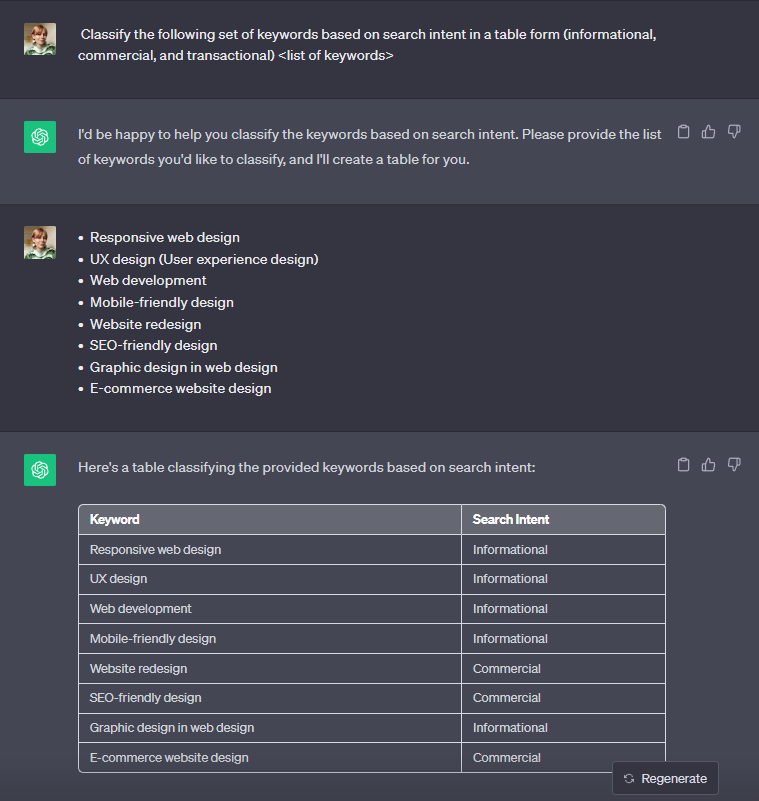
3. Group keywords by search intent
Once you’ve got your keywords it’s helpful to classify them by search intent. This will help you get a better understanding of where to place your various topics, articles and other content into a content funnel.
Here I asked ChatGPT to label the LSI keywords I acquired by search intent and here are the results:
On-page SEO and content optimisation
4. Create content pillars
If you really want to increase website engagement and drive leads, content pillars will become your new best friends. Staying on top of it with content creation or generating new ideas can get tiring over time – we’re not robots, after all! Speaking of robots…
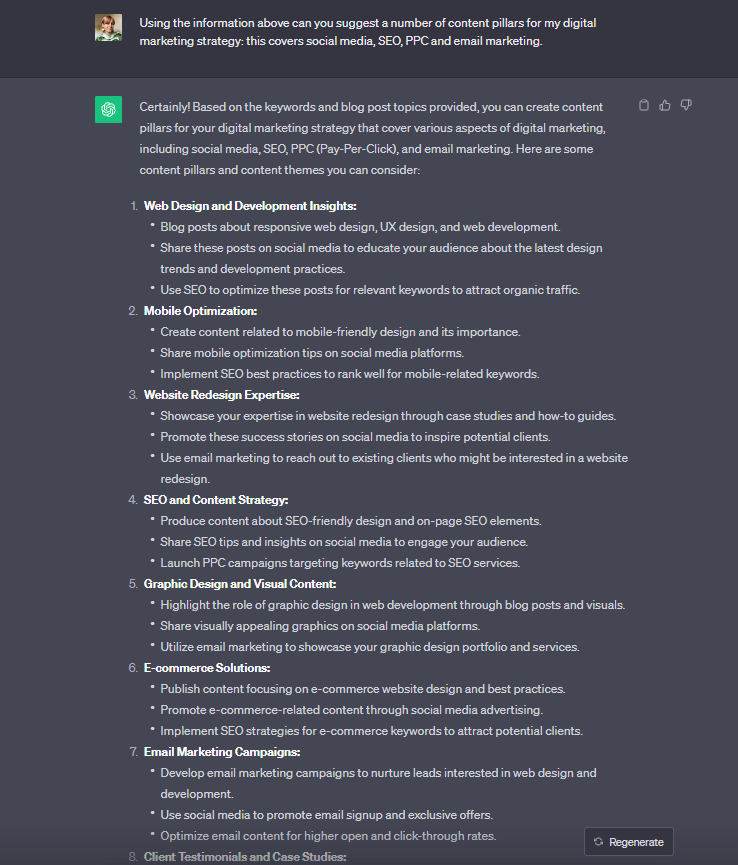
Did you know that you can ask ChatGPT to take your generated keywords and topics and put them into overarching content pillar? I know! It’s a gamechanger.
Going back to the web design examples above, I told ChatGPT to create content pillars for a digital marketing campaign covering social media, SEO, PPC and email marketing. Of course, in practice, you might want to create individual content pillar plans for each marketing channel – and, even better, you might want to provide additional context such as audience(s) – to get things even more granular.
5. Generating strong SEO titles
Another ChatGPT SEO hack is to use its generative powers to brainstorm the titles for your H1 headers and meta titles. Ask for it to generate you a whole list and pick and choose which elements work best for you – you can even request elements such as puns and alliteration!
6. Draft article outlines
Another handy time-saver is using ChatGPT to create a blog post outline for you. This works as a brilliant foundation that you can keep working on. Once you’ve got something to work from, it’s usually the case that your creative energy will start flowing.
7. Build a topical authority map
This one is a more complicated topic suitable for those ready to dive into the ChatGPT SEO deep end. A topical authority map is a great method for getting better SEO results in the long run.
In a sentence, topical authority is when a site aims to become the go-to source of information and authority on a particular subject area. A topical authority map or topical content map is a way of organising your website structure to help search engine bots navigate and understand it, no bumps along the way.
To create a topical authority map using ChatGPT, start by defining your topic and gathering information from the AI. Identify key concepts and terms, then organize them into a visual representation using mind maps, network diagrams, or concept maps. Add relevant information, review and refine the map, and periodically update it to maintain its accuracy and relevance.
Off-page SEO
8. Optimise meta data
As well as using ChatGPT for keyword research and various on-page elements, you can also use it for metadata. Whilst the AI is poor at understanding character limits and formatting, feed it your existing article and it will write you a summary in a sentence or two – ideal for getting your creative juices flowing.
9. Outreach email assistance
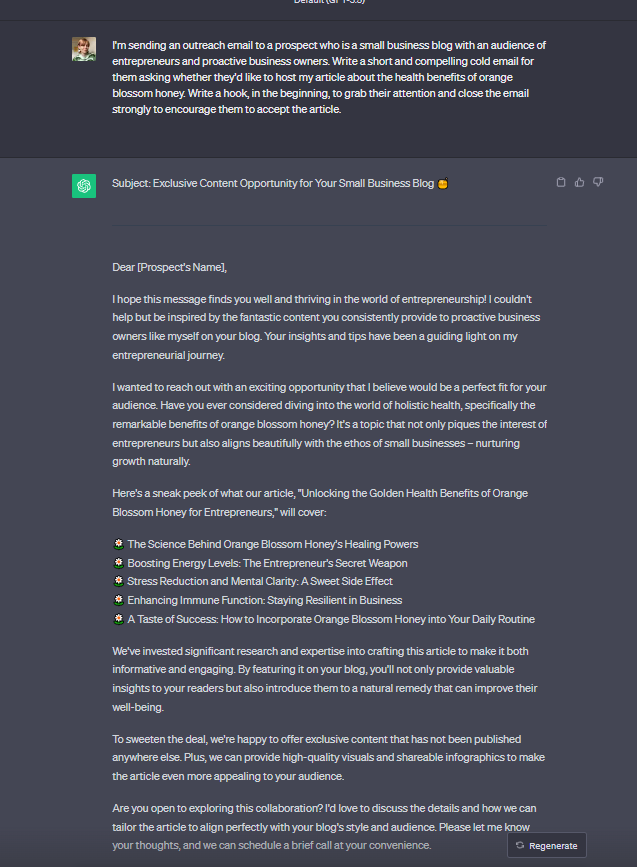
If you are working on building up your backlink profile without spending a penny, ChatGPT is a valuable resource. Pop in all of the details regarding your objective and the type of prospect you are cold emailing and allow ChatGPT to craft you a solid template you can tweak with each email sent out.
To give you an example, I posed as a business owner selling orange blossom honey and asked ChatGPT to write me a compelling guest post outreach email template.
Technical SEO
10. Produce markup schema
Schema markup is like a cheat code for search engines to figure out what’s on a webpage through structured data. Surprisingly, not many marketers take advantage of it to outshine their rivals. In the SEO world, this bit of code can help bots crawl and navigate your site, helping it rank more highly in the long-term. It’s kinda complicated, so why not give that task to your AI helper?
11. Create robots.txt rules
Finally, another cool trick that ChatGPT has up its sleeve is the ability to generate robots.txt rules. A robots.txt file is a text file that webmasters build to instruct bots how to crawl their websites.
In practical terms, robots.txt files serve as signposting to show whether specific user agents, AKA software programs designed for web crawling, are permitted or prohibited from accessing certain sections of a website. These directives for web crawling behaviour are established by either granting or restricting access for particular user agents, or even all of them.
This ensures that search engines focus on indexing and ranking the most important and relevant pages on your site, while avoiding irrelevant or sensitive content.

6 ChatGPT SEO pitfalls to avoid
1. Your prompts are too simplistic
If you provide simple prompts, you’re going to get simple answers. For the best results your Chat GPT SEO prompts should do the following:
-
- Be specific, in terms of the topic, issue or context at hand
-
- Ask open-ended questions
-
- Use straight-to-the-point, natural language
-
- Avoid overly complicated sentence structure
-
- Include relevant background information
-
- Consider the audience the content is aimed at.
2. You’re asking too much of it
There are some things ChatGPT simply can’t do – it’s only an AI language model, after all. It can’t make sophisticated predictions of the future, nor can it stay up to date with trends and industry information later than 2021. Another thing to bear in mind is that, while its function is similar to that of a search engine, ChatGPT cannot generate accurate data and statistics… even if it looks like it is.
Yep, sometimes AI Chatbots will generate full-chested responses with absolute confidence, when in reality it is talking nonsense. AI scientists call these “hallucinations” – and they can get quite bizarre!
3. You’re writing for robots, not people
SEO copywriting is more than pumping out content with a smattering of keywords. The true value of a content marketer lies in the marrying together of the human and non-human elements of search.
As well as the algorithm’s eagle eye on your content, there are aspects such as user intent, presentation, markup, formatting and humour. Without these, people aren’t likely to stop by for long and your bounce rates will leap up.
4. You’re ignoring E-E-A-T
There’s a slight overlap between this pitfall and the previous one. Your audience isn’t going to be engaged with content that doesn’t meet Google’s E-E-A-T criteria, and search engines aren’t going to like it either.
5. You’re using AI as a crutch instead of a supplement
When human editors aren’t actively reviewing the content being generated, the result is often a regurgitation of whatever ChatGPT hoovered up from the internet: the good, bad and outright ugly. This makes for generic, lacklustre content devoid of any truly unique insights.
What you want is a collaborative process. Chat GPT can help you lay the foundations of your SEO process or tweak the details, but it can’t be the meat of your strategy.
6. You’re diving in too deep
If your head is spinning from all the mention of technical SEO and automation, it might be time to turn to your resident SEO experts. An SEO agency will have a full arsenal of tools, insights and expertise at their disposal, including an intimate understanding of what makes search engines and AI tic.
With the experts at the helm, you can negate the time and energy it takes to get to grips with the nuances of search engine optimisation, and with humans in charge, you can rest assured knowing that your campaigns are in good hands.
Key takeaway: Chat GPT is NOT an SEO tool
Finally, before we wrap things up, let’s take a moment to pause and think about what we’ve learnt here. If there’s one thing that you should be taking away from this article, it’s that ChatGPT is not an SEO tool.
Whether your brainstorming buddy, spell checker or content writing assistant, ChatGPT should be the cherry on top of a robust SEO inbound marketing strategy. Unfortunately, AI isn’t going to send your outreach emails for you or conduct an audit on your website, but it can save you time in the ideation stages and help you polish up your copy.
Just make sure to avoid the pitfalls we mentioned earlier, and you will generate a set of responses that will shave off valuable time during the process and set you up for success.
Make a ‘bee-line’ to more efficient SEO strategy
There we have it: beefound.agency’s complete low-down on using ChatGPT for SEO purposes. If you have any burning questions left, or you want to learn more about the packages we offer as part of our ‘bee-spoke’ SEO services, please do get in touch. Let’s explore the future of AI and SEO together.