Consumer behaviour has been forever changed by the smartphone. With an all-powerful computer right there in our pockets, an estimated 91% of us turn to our phones to answer questions or look something up on a whim. Which is why it’s of paramount importance that businesses know how to enhance SEO.
Micro-moments, as Google calls them, are those unpredictable moments in which a customer decides they want to learn, read, buy or do something, and turns to their internet-connected smartphone to fulfil their spontaneous need.
By learning how to improve site SEO and boost Google rankings, you can make sure that it’s your brand, your product and your website which users land on when they make these snap, high-intent decisions.
Read on to discover how to enhance SEO and build your business online with a few expert tips from the ‘busy bees’ at beefound.agency.
Skip to:
- The benefits of enhancing SEO for your business
- How to enhance SEO, build your business and increase profit
- Conclusion
The benefits of enhancing SEO for your business
There are an endless number of benefits to search engine optimisation for small businesses and large alike, not least the potential for quality SEO to increase your company’s turnover. Below is a short, non-exhaustive list of positive outcomes to improving SEO.
- Increased brand awareness and improved reputation
- Higher ranking on Google search engine results improving brand ‘stickiness’
- Improved click-through rates, impressions and on-site conversions
- Increased web traffic to your website and relevant pages
- Gain a competitive edge over others in your industry, including larger competitors with deeper pockets
- Maximise marketing ROI and increase sales for overall improved turnover
How to enhance SEO, build your business and increase profit
Now that we’ve touched on some of the many advantages to enhancing your SEO, we hope you’re left wondering how to improve site SEO beyond its current state.
Even if you’ve already dabbled in search engine optimisation, the effects could be taking too long to show or may even have stopped working altogether.
Whatever the case, it’s time we taught you how to enhance your existing SEO, develop new winning SEO strategies, and take your online presence to the next level!
General steps to take when improving site SEO
As with any effective strategy, prior preparation prevents poor performance! Here at beefound.agency, that means in order to ‘make plenty of honey’ you’ve first got to know where the most ‘pollen-rich fields’ are! In other words, an SEO campaign is only as good as the research supporting it.
- Audit your site’s current performance and SERPs rankings: First things first, conduct an SEO audit of your website to find out how your current SEO efforts are affecting site performance and search engine rankings. From there you’ll be better equipped to identify areas which need improving.
- Conduct market research into competitor SEO: Knowing what your competitors are doing when it comes to website SEO is key to understanding where your own shortfalls are (as well as theirs!).
- Create a roadmap of short- and long-term SEO goals: Lastly, it’s no use launching into an SEO improvement campaign without knowing what you want to achieve. Both your short- and long-term goals should be clearly defined and mapped out—they will inform the direction(s) your SEO must take.
8 strategies for improving On-Page SEO
We can separate SEO into three distinct factions: on-page, off-page and technical.
Technical SEO is all about improving how a website functions (i.e., how smooth and effective a User Experience, UX, it delivers) as well as how easy it is for Search Engines to find and list.
Off-page SEO, on the other hand, concerns any activities conducted outwith the website in order to try and boost its rankings, such as building backlinks on other sites.
Finally, On-page SEO deals with how to improve website SEO by improving the website and its content. Let’s take a look at 8 provably effective on-page SEO tactics you can look to optimise.
1) Keyword research and use in content creation
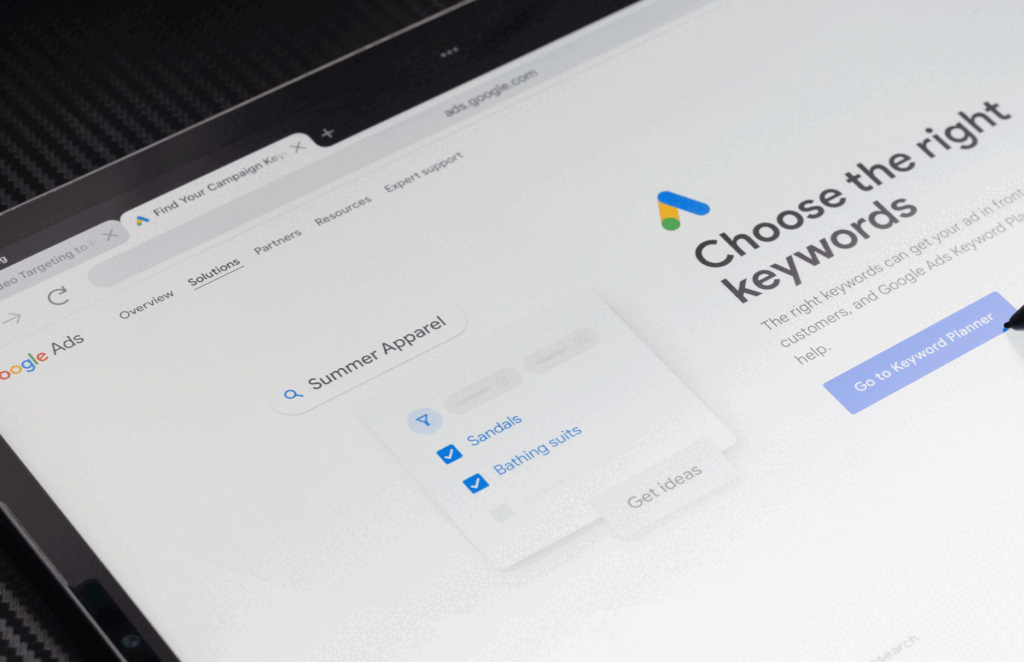
Keyword research is the cornerstone of any successful SEO campaign. The goal of keyword research is to identify the core search terms your target customer base are searching for most often—you can even use AI tools like ChatGPT to help streamline the process.
With this information to hand, you can then try to ‘rank’ on SERPs for the most relevant of these keywords to your business. You do so by producing high-quality and original website copy and content, which naturally features your chosen keywords.
Competition for keywords, however, is fierce. Most business owners with an online presence already know at least a little about SEO and have been pumping their content and copy full of the same keywords you want to rank for. This is where ‘keyword gap analysis’ comes in.
You can use keyword gap analysis to improve your SEO by identifying low-competition, high-intent keywords which your competitors aren’t writing about.
2) Headings, alt tags, and metadata
Another core feature of quality on-page SEO is ‘meta’, in the sense that it deals with not what’s visually on the page—not the copy or images, etc.—but with how the page delivers its content.
When Google’s search engine crawlers and algorithms are determining which webpages to rank, they’re not just looking for quality, useful and relevant original content. The algorithms also want to provide Google’s users with easily readable and accessible content.
Metadata, formatting with headings, and alt tags are all elements contributing to a more accessible webpage.
- Metadata: Metadata is a type of data which isn’t represented on the webpage itself, but is instead embedded in the HTML link to your page. Metadata tells a search engine user what a webpage is all about, meaning that the better your meta titles and descriptions are written, the more likely the end user is to click on your link. You should make sure to write meta titles, descriptions, and slugs for all of your website’s pages—each featuring relevant keywords from your keyword research.
- Headings: Google’s algorithms also like webpages that are neatly structured, and structured in a way that makes them easy to digest. To ensure quality formatting, which is most likely to enhance your SEO standings, be sure to format your pages with the correct use of H1 headings and heading tags.
- Alt tags: Google’s web trawler bots can read text and metatext just fine, but one thing it sometimes struggles to process are images. Thus, when you feature images on a webpage, it’s important that you help Google bots quickly and accurately assess the media by including Alt Tags! ‘Alternative text’, as Alt Tags are also known, describes the nature and function of the images you use, thus making your web pages more accessible, easier for Google to read, and more likely to rank higher on SERPs.

3) Content quality: E-E-A-T, YMYL and more
Whether you consider yourself a DIY SEO expert or are just starting out, trying to bring your business online and ‘bee’ seen by your target customers, it’s always worth reviewing the quality and content of your webpages.
It may once have been enough to pump your content full of keywords and expect Google to rank you on the first SERP. But this is no longer the case. These days, Google has cottoned on to the fact that many low-quality, generic or even outright plagiarised webpages were ranking simply because they were stuffed full of relevant keywords.
Quality of content has, therefore, become just as important as the keywords it contains. Here are a few pro tips on how to write really great copy and create truly optimised content:
- YMYL: If you’re producing content which could potentially impact a person’s (or society’s) health, safety or finances, then you’ll need to familiarise yourself with Google’s ‘Your Money or Your Life’ principles.
- E-E-A-T: ‘Experience, expertise, accuracy and trustworthiness.’ These are the four tenets of quality content writing promoted by Google. In essence, Google wants to be able to present its users with truly original, research-backed, up-to-date and informative content which adds value to the user experience and addresses their search.
- Accessibility: You might have the writing credentials of a PhD student or college professor, but Google’s not necessarily interested in you showing off your vocabulary. Instead, it’s more likely to rank websites which use straightforward, accessible language, shorter sentences, and concept visuals to make their content as digestible as possible.
4) Content regularity and relevance
Knowing how to enhance SEO isn’t just about what new techniques you can apply to your website, but also about how to elevate old techniques and content.
A great way to improve your website’s overall ranking is to delve into your back catalogue of content: webpages, blog articles, YouTube videos, etc. Look to update your content regularly to keep it relevant and accurate—that includes checking any outbound links to make sure the links still work, and updating any broken ones!
One particularly effective method for improving the SEO of old content is to repurpose it in the context of current user intent.
For example, let’s say you published a piece in 2022 about the launch of OpenAI’s first publicly available AI tool, ChatGPT, addressing early user concerns about the technology. Now, a few years on from that first launch and in the context of the wide global adoption of ChatGPT, you could repurpose your article to discuss how public opinion has changed and how the tool could benefit your readership.
It’s also worth looking at your content-publishing schedule. How often are you putting out new content designed to attract traffic and raise your ranking? The more consistently regular your output, the better you can establish your brand in both Google’s mind and the minds of your audience.

5) Restructure content for featured snippets
Have you ever Googled a query and found the answer awaiting you at the very top of the SERP—a paragraph of text, some of it in bold, above a webpage URL? This is what’s called a ‘Featured Snippet’.
Featured snippets, or rich snippets, are taken from webpages which succinctly and accurately answer user queries, so that Google can answer a customer’s question without them having to click on any links. (Future trends seem to indicate Google’s “AI Overview” will take precedence over featured snippets in time, though Google will still collect the featured information from well-optimised sites.)
If a customer wants to learn more on the particular topic they’ve just Googled, they’re likely to click on the link the featured snippet has been taken from. Hence why it’s worth restructuring, rewriting and regularly updating your content, in order to rank for as many rich snippets (or AI Overviews) as you possibly can.

6) Optimise your website for smartphones, tablets, and voice search
Smartphones and mobile devices are, far and away, the most popular mode of accessing the internet worldwide. Around 96% of global internet users used a mobile device to browse the web in Q2 of 2024, compared to just 62.8% via desktop computer or laptop. What does this mean for your SEO?
It means that your website must be optimised for mobile devices. When you’re building and enhancing the SEO of your site, you need to consider—first and foremost—how the site will look and how it will be navigated by mobile users. The more accessible and mobile-ready your webpages, the more likely they are to rank.
Similarly, more and more internet users are browsing the web using AI-enabled methods like Google Voice Search, or via smart speakers like Amazon’s Alexa. Over 50% of the global internet-using population uses a voice search at least once per day.
Techniques you can use to optimise your website for voice search include using conversational language in your writing, optimising your metadata for clarity and conciseness, and prioritising website load speed.

7) Prioritise website speed
Speaking of website speed… You could write the best, most original and most search-engine-optimised content the internet has ever seen, but if your website loads too slowly, no one is going to stick around to read it.
Another of the considerations Google’s web trawling systems make when assessing your webpages for SERPs is their load speed.
You can improve load speed by formatting your copy neatly and optimising the file sizes of any mixed media (videos, images, sound) you use. Use Google PageSpeed Insights to test your site and identify areas for improvement.
8) Add relevant and informative internal links
Lastly, it’s worth noting another simple, free SEO trick you can use to improve your website’s ranking: internal linking.
Internal links are those anchored naturally in your copy which link to another page on your site. The best internal links enhance a user’s experience (UX) by providing greater context or more detailed relevant information to a topic referred to briefly.
We’ve used internal links in this guide on how to improve your website and enhance SEO, for example, to provide you with detailed next steps you can take in your SEO journey.

3 strategies for improving Off-Page SEO
Improving your website’s SEO mostly takes place on-page, as we’ve just discussed. However, there are other ways to improve SEO which require more traditional marketing techniques like networking and paid advertising. Let’s take a look.
1) Building backlinks
Backlinks are a little different to the internal links discussed above. Backlinks are links featured on other sites which link back to your webpages. You may have written a really great guide on how to pick the colours for your brand, for example, to which other content creators want to link.
Each time an authoritative, trustworthy website backlinks to yours, your standing in Google’s eyes is raised. As such, an effective way to improve your site’s SEO is to build strong relationships with other site owners—either indirect competitors or sites outwith your field—and ask them to feature your backlinks.
Alternatively, you can write guest posts for popular blogs—oftentimes guest bloggers are allowed to include at least one ‘do-follow’ backlink to their own site.
2) Build even better backlinks with broken-link campaigning
If you’ve got the time and energy, you could even take your backlink game up a level by proactively pursuing opportunities. Broken-link campaigning is what we call the art of hunting down ‘broken’ links on other authoritative sites and campaigning to have these broken links ‘repaired’ with a link to one of your own relevant webpages.
3) Merging SEO into social media marketing
Younger generations are increasingly likely to turn to social media for answers to their queries before they are search engines like Google. If this trend continues, then the relevance of social media to your off-page SEO campaigns will grow stronger and stronger.
Social media advertising is, in and of itself, a great way to reach new demographics, expand your branding, and meet prospective customers on their own terms. By the same token, social media can also be used to redirect your followers to your site, thus generating more website traffic and as a result optimizing your SEO.
The on-page SEO techniques described in this guide should also be applied to your social media content marketing strategy, since social media profiles and posts are just as likely to appear in SERPs as are your webpages.
4) Pairing SEO with pay-per-click advertising
Pay-per-click (PPC) advertising, also known as Google Paid Search or cost-per-click (CPC), is an innovative advertising model whereby you only pay for your ad if and when it is actively clicked on by a user. Not only can this optimise the cost-effectiveness of PPC ads, but also makes them much more valuable in terms of cost-to-conversion ratios, compared to traditional non-targeted ads on billboards or in magazines, for example.
Whilst you can employ SEO techniques when copywriting your Google paid ads, this is not a necessity—given the success of your ad relies more on quality PPC bid management than it does, say, keyword strength.
However, evidence suggests that PPC and SEO can complement each other. Let’s take a look at some of the ways they do:
- The placement of PPC ads at the top of Google SERPs reinforces your brand name and message in the minds of potential customers, even if they don’t click your ad link.
- Quality SEO on the pages your Google Ads link to improves the user’s experience, thus reinforcing your brand reputation in their mind and typically increasing the time they spend on page—the latter contributing to SEO and your rank in SERPs.
- With a PPC ad and organically high-ranking optimised web pages on SERPs, you can take up more digital ‘real estate’ than before and, thus, increase your brand awareness.

Improving local SEO
Last but not least, let’s close this guide on how to boost Google rankings with a brief discussion of the benefits of local SEO—especially for smaller businesses.
Local SEO is a subtype of search engine optimisation which seeks to put your webpages in front of a geographically localised audience. Local SEO is of most use to businesses with bricks-and-mortar units in one or more physical locations. It can be especially useful as a way to gain a competitive edge over rivals with deeper pockets.
When it comes to improving your local SEO rankings, most of the tips and techniques discussed in this article still apply, with one amendment—they should be enhanced with local elements.
For example, when researching keywords, research which keywords are being used in your specific areas. Write your copy and content using keywords which pertain to those local areas, or which include key local SEO phrases like “near me” or “nearby”.
You can also improve local SEO by linking your Google Business Profile to your website and Google Maps listing, and by encouraging local patrons to leave reviews of your business on Google.
Conclusion
Search Engine Optimisation (SEO) is fundamental to the success of any business’s online presence, and likely will remain so for the foreseeable future. Getting SEO right can take time, money, human resources and a generous helping of patience.
Knowing how to improve website SEO, not just when you’re starting out online, but regularly and iteratively throughout your business’s lifespan, is key to the growth of your brand. We hope that with the tips, tricks and expert insights provided in this guide you now feel confident about how to enhance SEO for your own business.
Of course, we know that not every enterprise—big or small—has the resources to commit to a fully-effective SEO campaign. Perhaps you established a good SEO structure for your site but lack the time to maintain and upkeep it, or you just feel overwhelmed and don’t know where to start. If these scenarios describe your situation, don’t worry. Professional help is just around the corner and the ‘busy bees’ at beefound.agency are primed and ready to help you excel in SEO