If you know anything at all about SEO, you’ll likely have started your journey into this niche topic via a blog post or discussion on keywords. After all, they’re one of the easiest places to start. As SEO professionals, we often see the same sorts of queries crop up, namely “How many keywords for SEO do you need per page?” And, “How many keywords should I use for SEO overall?”
Good questions.
We’re going to answer them shortly, so buckle up while we discuss exactly how and where to use your keywords, helping you settle on the ones that will elevate a functional website to a busy one. First up, let’s lay the groundwork.
Skip to
- SEO keyword fundamentals
- How many SEO keywords should I use?
- Per digital marketing strategy
- How to use keywords
- Bonus keyword tips
- Closing thoughts
Let’s be honest – keywords are still a core part of SEO, whether we like it or not.
At beefound.agency, we’re big believers in looking beyond surface-level metrics like keyword rankings, but there’s no getting around the fact that showing up on the first result page for terms with a solid search volume usually means more eyeballs on your site, and potentially more business coming your way.
Now here’s a bombshell: almost 70% of all online experiences begin with a search engine. Searchers type in a term, Google pulls up a list of (hopefully useful) results, and voilà – they’re off down the rabbit hole. So, the further from that first page you are, the more your chances of being clicked on dwindle.
That’s why keywords, when used smartly and efficiently, are your ticket to more organic traffic. A well-thought-out keyword strategy helps push your pages higher up the search results and attract the right kind of traffic. It’s also a big reason why we’re constantly shouting about the power of consistent blogging and wider content marketing, especially for small businesses. Every piece of content is another opportunity to rank.

What are SEO keywords?
We’ve mentioned the positive impact that incorporating SEO keywords into your website content can have on your traffic, but what exactly are SEO keywords? Let’s break it down.
SEO keywords are the terms or phrases in your content that make your site discoverable via search engines. They encapsulate the essence of your content, connecting with your target audience and driving organic traffic.
Think about it in two ways.
- If you were to boil down everything on a webpage into a string of words or phrases, these would be your keywords for that page.
- Put yourself in your ideal customer’s head. What words would they use while searching? What is the intent behind their searches? You’ll want to marry these queries with the keywords on your page.
In other words, selecting the appropriate keywords for a page is all about speaking your audience’s language and getting granular with your wording. Using relevant and targeted keywords enables you to:
- Connect with your desired audience(s)
- Enhance the organic traffic to your website
- Improve conversion rates
What makes a good keyword?
Now that you know exactly what keywords are, you’re likely wondering what makes for a good keyword. Spoiler alert: it’s not just about picking the ones with the highest search volume.
A good keyword will hit the right mix of relevance, search volume, competition, and conversion potential. It really is a bit of a balancing act: aim too high, and you’re competing with giants, but aim too low, and no one’s searching.
Search volume
Search volume tells you how many people are searching for a term (usually each month). Naturally, you want to use keywords that people are actually typing into search engines, otherwise you’re practically shouting into the void.
But there’s a twist: bigger doesn’t always mean better. High volume keywords often come with high competition. In these cases, a lower-volume keyword with strong searcher intent can be more valuable because it attracts better leads and is easier to rank for.
Relevance
This might seem obvious, but it’s often overlooked in the chaotic research phase. A keyword should align closely with what you actually offer – your product, service or content goal – and the interests and intentions of your target audience.
To put it simply, if you rank no.1 for a keyword but the people searching it aren’t interested at all in what you provide, that traffic won’t convert, and in turn you’ll be bumped down the rankings, leading to a downward spiral into even lower traffic.
Competition/Difficulty
Keyword difficulty measures how hard it is to rank for a keyword, often based on the strength of the existing content and backlinks of the first SERP for that query.
If you’re just starting out or don’t yet have a strong domain, pursuing super-competitive keywords might not be worth it. Instead, focus on long-tail keywords (more on that later), and niche phrases that your competitors might be ignoring.
Conversion potential
Some keywords are better at converting visitors into leads, subscribers, or customers. These often include a transactional intent (such as “buy X” or “near me”) or very specific enquiries (“best CRM for estate agents”).
A keyword with high conversion potential might not have massive traffic, but it does bring in visitors who are ready to act. To determine the type of search intent, take a look at the kinds of pages that are ranking currently. Product pages may indicate that the intent is more transaction based, whilst blog posts could suggest a more exploratory motivation.
Primary vs secondary keywords
Besides specificity, keyword variety can go a long way to support your SEO efforts. This is because, alongside your primary keywords, secondary keywords help you clinch additional search terms that cast out your digital net further. In fact, they complement each other.
Primary keywords represent the core focus of a page, while secondary keywords provide additional context, depth, and relevance. This means more refined and relevant content that addresses nuances and subtopics within your main subject.
For example, if you wanted to exploit SEO for hotels, you might opt for the primary keyword “hotel content marketing” and pair it with “social media in hotel content marketing” or “effective hotel content marketing strategies.”
From an SEO perspective, a sophisticated balance between primary and secondary keywords will demonstrate that you’re not just plugging in a single keyword for the purpose of ranking. No, you’re providing an in-depth understanding of the topic at hand and what users are searching for. In the eyes of Google, this is higher-quality content that better satisfies the audience’s needs.
Long-tail vs short-tail keywords
In the spectrum of SEO keywords, there is also a crucial difference between long-tail and short-tail keywords.
Short-tail keywords are more generalised search terms made up of one or two words, whereas long-tail keywords are typically 3-5 words, but often longer.
Long-tail keywords offer specificity, catering to niche audiences, while short-tail keywords target broader audiences and are typically harder to rank for. The art lies in understanding when and how to leverage each for optimal impact.

The sweet spot: how many SEO keywords should I use?
Time to unveil the secret you’ve been waiting for: how many keywords do you need in order to excel in the organic search game? Ready for the answer? In typical webmaster fashion…
It depends.
To help you navigate the numbers, we’ve broken it down into three core areas: how many keywords per page, how many per website, and how many for your overall digital marketing strategy.
How many SEO keywords per page?
One primary keyword per website page is an absolute must for SEO. But, generally, you should aim to gather 1 to 4 well-researched keywords around a single topic for each page – that’s one primary keyword and up to 3 secondary keywords. This will allow you to target a wider yet still highly specialised audience with similar search intents – just be careful not to fall into the trap of trying to rank for your secondary keywords at the expense of your primary.
If you find a secondary keyword with a clear-cut variation or a slightly different search intent, ensure that you create further pages that go into more detail for that particular query. It’s better for SEO, and your readers will thank you for the clarity.
Why one primary keyword per page is sufficient
There are plenty of reasons why one primary keyword is enough, but here are three:
1. Pages need one clearly defined topic
It sounds pretty straightforward, right? But if you go deeper, it can actually get a bit more complicated. The best way to get your head around it is from a user experience point of view.
Think about when you’re doing a cheeky Google search yourself. If you looked up “Vegan chocolate cake recipes” you’re probably not going to be interested in a page that talks about Vegan cookies, however closely related these terms are.
People are looking for specific content online, so it’s not advisable to make them trawl through a load of additional content that doesn’t serve them.
Considering Google’s purpose is to help users pinpoint precise information, it prefers showing pages that focus on one specific thing instead of trying to cover many topics at once. So, if a page tries to rank for many different things all at once, it might not be shown as much as a page that concentrates on just one topic.
2. Google has your back with close variations and misspellings
You’ve probably noticed how Google treats typos?
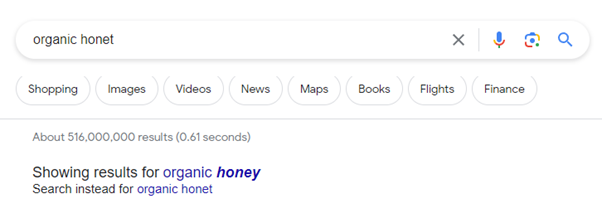
Like your favourite English teacher, Google will predict exactly what you meant to type and correct your spelling. But did you know that it does the same thing for both close variations and synonyms?
Yep, that’s right. Search engines will go out of their way to rank pages for keywords that share the same meaning and intent without you having to go through and add them manually. It’s able to recognise that users search for the same things with different queries. Clever, huh?
3. You only need to optimise for one keyword to rank for hundreds of them
According to a study by the SEO buffs, Ahrefs, the page that holds the average top ranking at position #1 will also be found in the top 10 for nearly 1,000 other related keywords. This isn’t limited to high-traffic keywords; the same trend persists even for less commonly searched terms!
The cherry on top? Each keyword brings traffic independently, meaning that a post optimised for a single keyword can reach far broader audiences than you initially expect.
Why secondary keywords are important in SEO
We briefly touched on it earlier, but it doesn’t hurt to reiterate the importance of your secondary keywords.
Secondary keywords help you cover the chosen topic thoroughly, meeting your readers’ expectations. Paired with the extra semantic variation, you can also keep your copy fresh and interesting.
Once your page is out there, they boost your chances of ranking for not just one, but hundreds or even thousands of different keywords, not just the main one.
Think of SEO like fishing – focusing on the primary term is like having just one reel in the water. On the flip side, adding secondary keywords is like having dozens (or more) reels. You might not snag the big fish you hoped for, but you’ll catch something.
And who knows, one of those secondary keywords might turn out to be the real winner for your ranking.

How many keywords should a website have?
For SMEs, a well-rounded SEO strategy might target anywhere from 50 to 200+ keywords, spread across core pages, blog content, landing pages, and resource collections.
These keywords will vary in importance, and thus some will appear more often than others. For example, a local café might prioritise “best coffee in Brighton” as a high-impact keyword to include in more of their content, while also targeting lower priority phrases like “latte art tips” on supporting blog posts.
Larger businesses or those in particularly competitive industries (think finance, legal or tech) might be chasing even more – but they also have the manpower and budget to match.
Building a keyword ecosystem: pillar pages and internal linking
For top-level pages, such as service pages, a primary keyword on its own or with 1 to 2 secondary keywords as synonyms will be the most impactful choice. These are your pillar pages, and they should act as hubs that link out to lower-level, supporting posts contextually and where natural.
This is where internal linking comes in.
Linking from your high-level pages to relevant blog posts or subpages not only helps users navigate your site logically, but it also helps search engines understand the structure and relationships between your content. Think of it as leaving a trail of breadcrumbs that guides both search engines and your customers. If you’re clever, you can even plan your paths intentionally, leading users step-by-step along the buyer’s journey and making them better positioned to make a purchase decision.
How many keywords for an overall digital marketing strategy?
Overall, there’s no fixed number of keywords a business must rank for: it really does depend on the size of your brand, the breadth of your resources, and the depth of your content.
That said, bear in mind that the more keywords you want to rank for, the more content, time, and effort you’ll need. Every target keyword typically deserves its own page (or at least a focussed section), and each page needs optimisation, linking, monitoring, and ongoing updates.
And keywords aren’t just for your website. The right keywords play a big role in your off-page SEO too. Think about SEO for your Google Business Profile, optimised YouTube content, outreach efforts, or even paid search campaigns: each of these also benefit from integrating a solid keyword strategy.
If your keyword list is growing faster than your to-do list can handle, that’s a sign that it might be time to outsource some of your SEO work to a team of specialists (hi from beefound.agency!) who can manage it strategically and sustainably.

How to use SEO keywords
We’ve covered how and why keywords work, but where do we put them? To use keywords effectively in your content you will need to insert them evenly into your content as follows.
Include your primary keyword in your:
- Meta title
- Meta description
- URL slug
- H1 header (and one lower-level header if appropriate)
- Alt text for images (not all)
- Introductory paragraph
- Final paragraph
Along with your secondary keywords, you can incorporate them naturally into the body of your content (you don’t want to load them into one place!). Secondary keywords can also be included in headers H2-H6.
Finessing your keyword research
One of the multitude of reasons why your website might not be ranking could be related to the specificity or intent behind your chosen keywords, so thorough keyword research is advisable.
Whether you start by brainstorming your SEO with ChatGPT or exploring Google’s “Related Searches”, eliminate the need for guesswork and use what tools are available to you.
Pick a keyword research tool that’s the ‘bee’s knees’
Speaking of tools, there is plenty of handy software out there that you can use to analyse what terms your competitors are ranking for and close the gap on them. By snagging higher volume and more specific keywords they’re lacking, you can really get ahead in your market.
Finding out what your pages already rank for
Another important aspect of the process is looking at what you already rank for. Our go-to tool for this is Google Search Console. Plug in your site and see what queries your pages are generating, view their clicks, impressions and conversions, and do some good ol’ fashion deduction to work out what’s working for you and what’s not.

Understanding keyword density
Keyword density, AKA keyword frequency, is a crucial aspect of on-page SEO. Basically, it means the percentage of times a target keyword or phrase appears compared to the total number of words on a page.
Achieving the right keyword density is a delicate balance; too little may result in poor search engine visibility, while excessive usage can lead to keyword stuffing and potential penalties from search engines.
What is keyword stuffing?
Keyword stuffing is an SEO malpractice that involves unnaturally overloading content with keywords in an attempt to manipulate search engine rankings. This outdated and frowned-upon technique aims to deceive search algorithms by artificially inflating the keyword density. Nowadays, search engines have become sophisticated in identifying and penalising such practices.
As you might expect, engaging in keyword stuffing can lead to a negative user experience, as the content may become awkward, unreadable, irrelevant or just downright annoying! Search engines prioritise quality content that genuinely addresses user queries, so going overboard with your keywords will reflect poorly on your content and your site.
Keywords in numbers: the golden formula
Determining the ideal number of keywords for SEO involves considering various factors, including the length and purpose of your content. The golden formula therefore revolves around maintaining a balance between primary and secondary keywords, ensuring relevance and depth.
To strike the optimal balance, consider the length and nature of your content. For longer articles, a keyword density of 1-2% is generally recommended. However, it’s important to prioritise natural language flow over forcefully inserting keywords – as we mentioned, that’s a real no-no.

Bonus keyword tips!
Overlap primary and secondary keywords
When you’re working hard to include both primary and secondary keywords in your content it can be difficult to sound natural.
By overlapping them you can essentially kill two birds with one stone, blending two keywords into one phrase. For example, if your primary is “restaurant in York” and your secondary is “dog friendly restaurant” you could decide to mash them together to make “dog friendly restaurants in York”.
Limit your content to a maximum of three secondary keywords
To avoid keyword stuffing (see the section above if you missed it), stay within a limit of 4 secondary keywords not including your primary one. This will ensure that you don’t overexert yourself in terms of topics and put off your readers. Remember: quality not quantity!
Include each secondary keyword at least once in your content
You’ve conducted the secondary keyword research for a reason, so don’t let it go to waste. As you would with your primary keyword, sprinkle them in naturally rather than forcing them in.
You can double-check your keyword density by holding down CTR+F and searching for that term in your content once it’s finished and make any necessary tweaks.
Include internal links with both primary and secondary keywords
At this point, the content should be completed and ready to go live. But before you hit “publish”, think about adding some internal links to your keywords to bolster your SEO signals. If you have a relevant page on your site or a recent blog post on an adjacent topic, you could link them in the text to indicate that your pages have shared relevance – an extra dash of SEO juice, cheers!
How many keywords should I use for SEO? Closing remarks
Long story short, when it comes to SEO keywords, there’s no one-size-fits-all answer. The key lies in understanding your audience, crafting content that resonates, and leveraging keywords strategically. So, whether you’re just starting or refining your existing strategy, focus on our best practice tips to ensure that your keywords hit that sweet spot and get your site noticed. Happy optimising!