Ah, Amazon. The goliath of online shopping. From next-day delivery groceries to white label products and even handmade wares, there are a staggering 250 million unique items hosted on the platform. When paired with the 310 million active users currently on there, it’s fair to say that the platform is bustling. “What’s the catch?” you ask. Well, with activity comes competition. Without optimising Amazon listings, your products are simply going to be lost in the noise.
Enter this beginner-friendly guide from the search engine experts at beefound.agency. Designed for e-commerce solopreneurs and SMEs alike, it’ll explain exactly how Amazon’s search system works and then share the best practices for Amazon listing SEO. Spoilers: there’s a lot more to it than simply describing your products.
Skip to
- What is search engine optimisation (SEO)?
- Best practices for optimising your Amazon listings
- Bonus advice: Ranking beyond Amazon
- Amazon SEO tools
- Conclusion
What is search engine optimisation (SEO)?
Before we go any further with this guide, let’s make sure everyone is on the same page. Whether you’re completely new to the concept or fancy a refresher, here are the must-know facts.
SEO, or search engine optimisation in its full form, is the process of making your content more discoverable to people through search engines. In the most basic sense, it’s all about ensuring that your online output – virtual shopfront, blog posts, product listings etc. – meet the criteria to rank.
While there are subtle differences between platform algorithms and search engines, the fundamentals often remain the same: producing high-quality, relevant, authoritative and trustworthy content that matches the intent behind your audience’s search queries. Do all of this and you stay in the algorithms’ good books, all whilst reaching the right people at the right time.
Top tip: With this kind of SEO, it’s best to think about the Amazon search box as the equivalent or mini version of a search engine (which it is!).
How it works on Amazon: 5 elements of search
Let’s get back with the program: optimising Amazon listings. Well, to do so, you’re going to need a proper understanding of how Amazon search works. Fortunately, we’re already a step ahead of you.
1. The search box
According to a survey by Power Reviews, 50% of consumers start their purchase journey on Amazon. This means that the search box is often the first step of a multi-stage research process as people shop around for the best deals.
Here, customers can find products by typing in queries and scrolling through the results or exploring one of the drop-down categories in the menu. With Amazon listing SEO, the idea is to reverse engineer this process via keyword research; at its simplest, you’re anticipating what users are searching for and aligning your listings not only with those search terms, but shopper expectations.
Think of it this way: if a customer is looking for a glass jewellery box and has typed the term into the search bar, your products aren’t going to show up in the results if you haven’t used relevant, descriptive language in your listings – even if your product is exactly what they’re looking for.
We’ll go into more detail about using keywords later on in this guide, but suffice it to say, getting your keywords right is the foundation of visibility on Amazon.
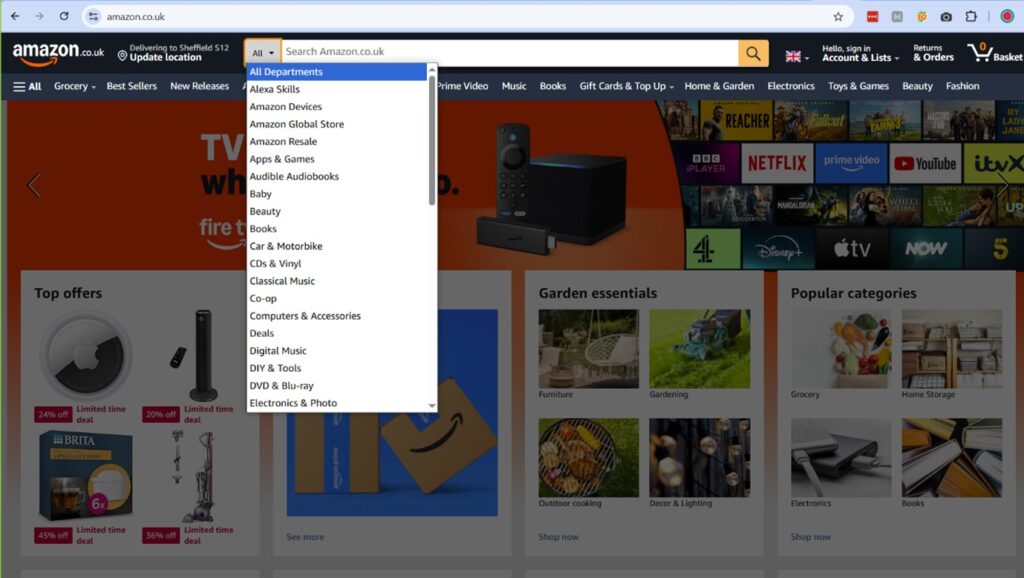
2. Search filters
One of the reasons so many people use Amazon is due to its sophisticated filters. From delivery day and pricing to subcategories, gender demographics and customer review star ratings, there are a plethora of ways to refine your search.
In the context of optimising your Amazon listings, this is a goldmine of opportunities. After all, the more detail you provide on your listings, the easier it is for you to filter out the competition (quite literally!).
3. Search result pages
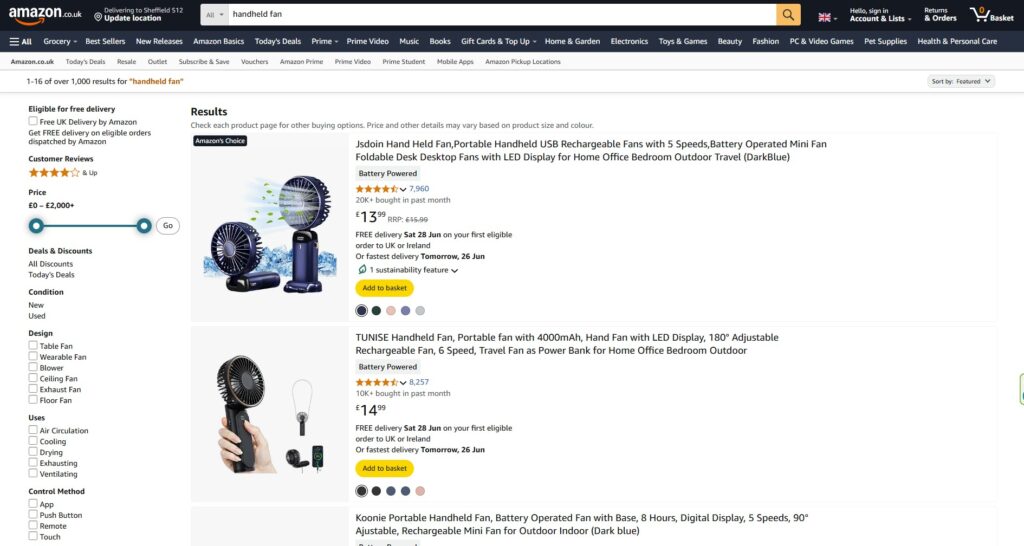
The Amazon search results pages are where all the action happens; it’s the reams of listings that appear under your query, typically with a handful of Amazon’s Choice products above the regular results. Optimising your Amazon listings can help you get higher up in both the regular results and in those coveted Amazon’s Choice badge slots.
The latter are particularly helpful when it comes to winning trust and driving clicks. Looking at the example below, imagine you were on a mission to find a functional hand fan to cope during a summer heatwave. In a rush, and seeing the badge of approval, it’s much more tempting for customers to click on the top option.
4. Amazon Best Sellers
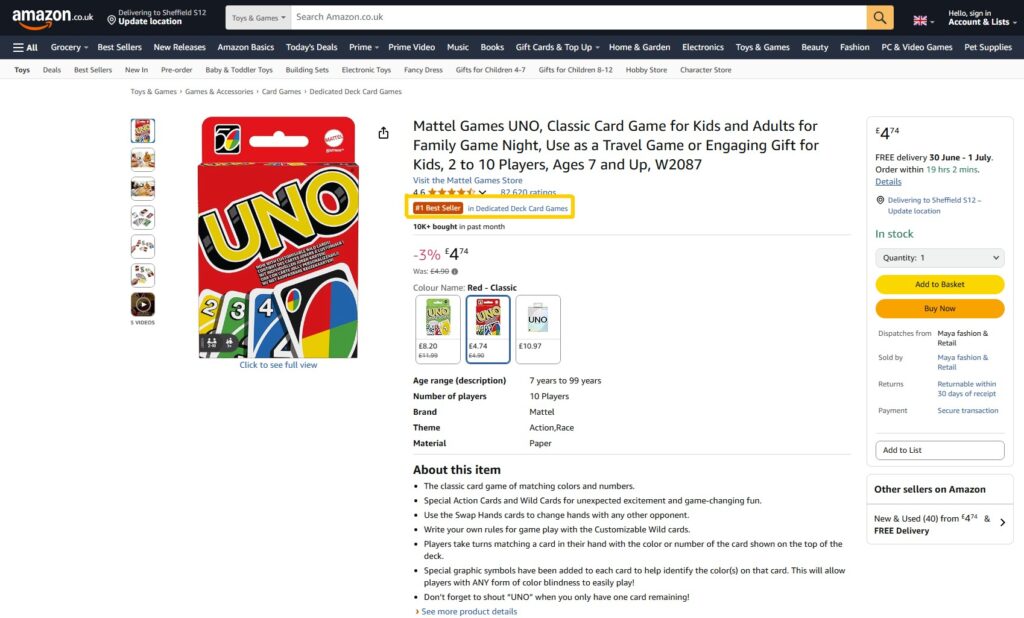
If you truly want to reach a greater pool of customers and snag more sales, you can’t ignore Amazon’s Best Sellers page and the role of the Best Sellers Rank (BSR) in getting your products featured there. The page is exactly what it sounds like: a space where Amazon’s most popular products are spotlighted, based on real-time sales.
This is where BSR comes in. The score indicates a given product’s sales rank compared to similar products on the platform, and the higher your score, the higher you appear in the category league table. While not considered a direct contributor to your Amazon listing SEO, it’s worth aiming for a decent score because, when it comes down to it, a good BSR leads to better sales. And, get this: many of the tactics you use to improve your rating also increase your chances of ranking organically, so in a roundabout way, Best Sellers Rank does make a difference. Aiming for the top 10-20% is a good starting point.
We have a dedicated guide on Amazon Best Sellers Rank, so if you fancy doing a bit of extra homework, do give it a read.
5. Sponsored Products and ads
Cost-per-click ads, just like those you see across search engines and social media, also exist on the Amazon marketplace and take up an interesting space in the platform’s internal ecosystem. They come in a number of different formats, the main ones being:
- Sponsored products: Classic, keyword-targeted ads that appear within the search results and product pages, showcasing individual products. These are best for bottom-of-the-funnel sales efforts – convincing purchase-ready customers to buy.
- Sponsored brands: A brand spotlight including a custom headline, logo and selected products. These appear above, alongside or within shopping results and are more catered towards brand discovery and awareness.
- Sponsored display: Another brand/product highlight, these Amazon ads have wider reach, appearing not only across the search results but on the Amazon homepage and on Amazon-owned and partnered sites too.
The reason that these Amazon ads are relevant lies in their ability to drive traffic towards your listings. The more traffic they receive, the more Amazon’s algorithm is going to take note of your popularity and bump you up its search engine results page. It’s a bit of an ‘I scratch your back, you scratch mine’ situation – both parties earn more sales. So, when you’re advertising your e-commerce brand, you are also giving your search visibility a boost. Yep, positive signals from your Amazon ads are ranking factors. Speaking of…
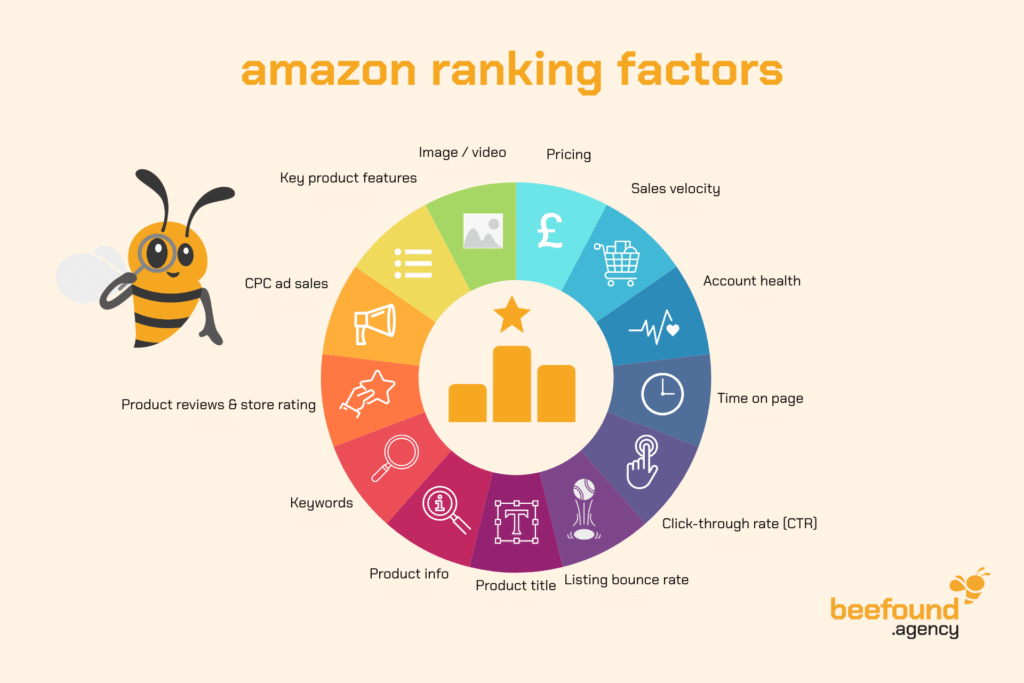
The key pillars of ranking
Now that we’ve covered the main components of Amazon’s search ecosystem, let’s get into more depth about how the platform decides to rank products, and what you can do to put your listings in good stead for appearing higher up in the results.
Sales Rank and velocity
We’re putting this at the top of the list because, of all of the factors that go into Amazon’s search algorithm, this is by far one of the most important.
Sales velocity refers to the volume and value of sales over a given time. Unlike with Google searches, which are primarily informational, Amazon’s search is purchase-driven. Practically all keywords are transactional in nature – after all, customers are on the site to buy things. This explains why Best Sellers are a mainstay at the top of the results for most queries.
In a nutshell, the more you do to increase the chances of clinching sales, the more likely your listings are to rise up the rankings.
Keyword relevance
Keyword relevance is also up there when it comes to ranking organically in Amazon. It simply indicates how well a selected keyword matches the product being offered and the search terms used by potential customers.
Pricing
One of the many reasons Amazon caused such a shakeup in the retail world was due to its ability to drive competitive pricing. While a bit of a minefield if you jump down the rabbit hole, the most important thing to note is that its algorithm is constantly switching up the cost of products as it chases higher returns, actively prioritising competitively priced items.
Conversions and click-through rate (from listings and ads)
High click-through rates – that is, people clicking through to your product pages from either your listings or ads – are a must if you’re wanting to maximise your visibility on the platform. The exact same is true of conversions. These metrics are taken as evidence of popularity and product quality.
Product listing completeness
As we mentioned in our explainer of Amazon’s many filters and categories, the more complete your listing is, the easier it is for potential buyers to refine their search and find exactly what they’re looking for.
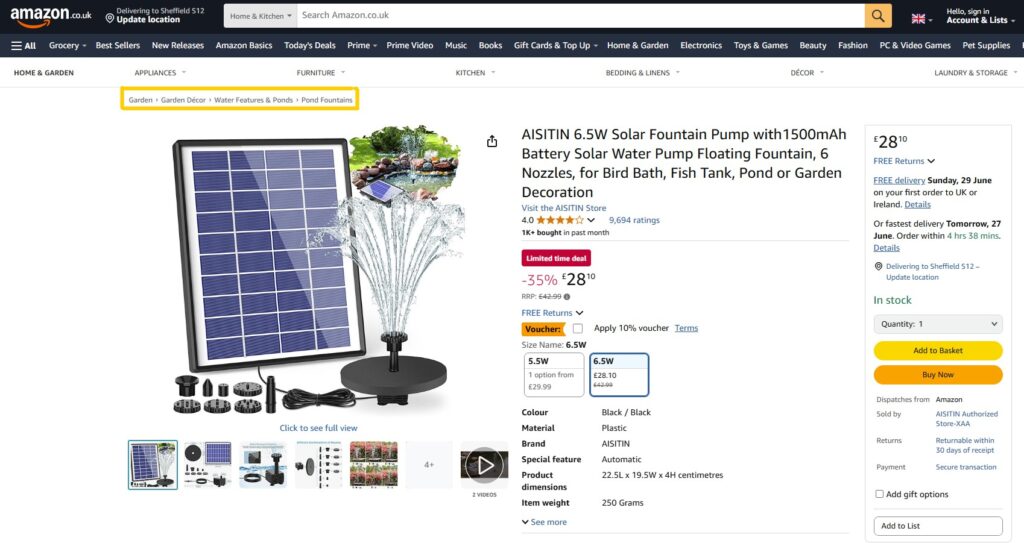
At an even simpler level, your listing may appear across more pages. For instance, this solar-powered fountain pump appears under Garden, Garden Décor, Water Features & Ponds and then Pond Fountains. Very specific! But also, extremely useful for people browsing the site.
Images and video
In today’s visual-first digital world, image and video dominate the scene. Driving increased clicks, more conversions and ultimately enhancing the customer experience, they’re on the algorithm’s radar, and should be on yours too.
Stock supply
Of all of the e-commerce platforms out there, Amazon is most known for its convenience and customer-centric approach. Which is exactly why stock supply is a ranking factor. To do well in the search results, you’ll need to ensure you have buffer stock for inventory downturns to avoid the difficulty of shifting those last units, which may not appear as prominently.
Review signals
As we explored in our online reputation x SEO guide, reviews are everything when it comes to proving your worth – and Amazon agrees. This is why you’ll find a positive correlation between the volume of high-quality product reviews and Amazon SEO.

Best practices for optimising your Amazon listings
If you’ve been paying attention to the ranking factors, you may have already sussed out that most of your Amazon listing optimisation hinges on improving your visibility on the platform, enhancing customer experience, improving conversion rates and getting your product return rates down. Here’s how you can do that in practice.
Centre the audience intent
Effective Amazon listings start with one thing: your customers. What are they searching for? What words do they use? What questions or concerns might they have? Aligning your listing content with audience intent is about stepping into your buyers’ shoes and anticipating their expectations. Things as simple as providing insights into recyclable packaging, in the case of eco-friendly brands, can help product descriptions resonate with readers and, thus, increase your chances of converting interest into action.
Get keywords in all the right places
Keyword relevance is crucial to Amazon SEO. You want to make sure your main keywords appear naturally in your product title, bullet points, description, and backend search terms.
A smart tactic here is to focus on both high-volume keywords and long-tail variations that are more specific to what you’re selling. High volume to induce higher rates of traffic, and long-tail keywords to bring higher-intent buyers into the picture.
Don’t forget to revisit and refine these keywords regularly; shopping habits change, and so your strategy should be nimble to keep up.
Spy on the competition
You’re not selling in a vacuum. Amazon is a bustling marketplace, so keep a close eye on what your top competitors are doing. What keywords are they targeting? What sort of photography and descriptions do they use? Reverse-engineering your competitors’ listings can give you valuable clues on what works (and what to avoid) in your own niche.
Invest in your product photography…
Your photos do the heavy lifting in convincing customers to click and convert. Amazon shoppers are visual, and high-quality imagery builds trust fast. Make sure you have clear, high-resolution photos showing your product from multiple angles. Where appropriate, include lifestyle images that show the product in use. Not only do good visuals help you meet Amazon’s listing completeness standards, but they also keep your click-through and conversion rates healthy, both of which influence your rankings.
…And don’t skimp on alt text
Yep, even on Amazon, accessibility matters. Adding relevant keywords into your image alt text not only helps with searchability but also makes your listing more inclusive. Keep the alt text descriptive but concise: think “foldable silicone water bottle – 500ml – sky blue” instead of just “bottle.”
Resist overstuffing your listings with keywords
It can be tempting to cram every possible keyword into your product description, but trust us, it backfires. Relevance and reliability are just as important as keyword targeting, and for this reason, you should always incorporate them sporadically where natural. Always prioritise real shoppers over the algorithm; no one likes clunky keyword spam.
Pair Your Amazon SEO with Sponsored Product Ads
Organic visibility is the goal, but sometimes a well-placed ad can give you that extra push. Sponsored Product Ads can drive more traffic to your listings, which in turn increases your chances of getting noticed by Amazon’s ranking algorithm.
Enrol in Amazon Brand Registry
Brand Registry gives you access to tools that make your optimisation efforts easier and more effective, from A+ Content to Brand Analytics. If your products carry your own logo or design, registering your brand unlocks new ways to personalise and protect your listings, making them more credible and appealing. See how this coffee maker has integrated product imagery and videos?
Optimise your optimisation
What’s better than optimising your listings? Optimising how you optimise. Tools like Helium 10, Jungle Scout or even Amazon’s own Brand Analytics can save you hours of guesswork. With the right setup, you can automate pricing, streamline keyword research and track what’s working. The proof in the pudding is that, on average, sellers who use Listings apps list their products 37% faster – and in a world where time means money, that’s a pretty sweet deal.
Get specialist help when you’re stuck
We get it, you business owners are some busy bees. That’s why outsourcing your marketing can save you stress, hassle and money while you manage your day-to-day operations. From paid ad management to advice from the SEO specialists, there are plenty of ways to ensure your listings are working as hard as they can.
Bonus advice: Ranking beyond Amazon
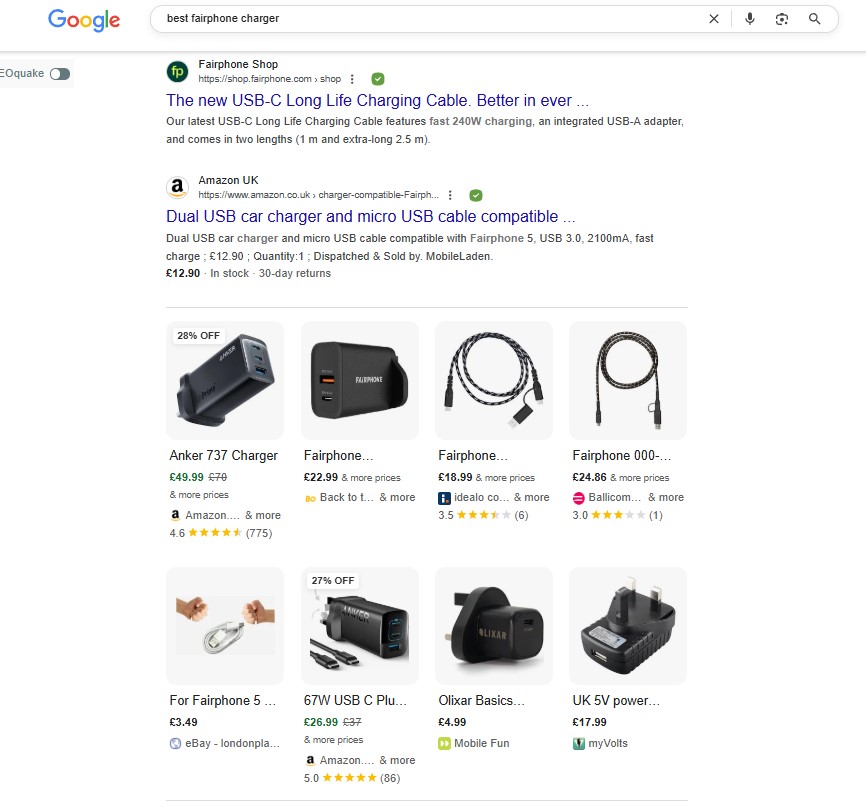
Here’s a helpful tidbit you probably wish you knew earlier: it’s actually really easy to outrank Amazon products within a search engine like Google, despite the fact that half of product searches start on Amazon.
This means that, if you have the capability (and the budget), it’s well worth your buck to consider a multichannel retailing approach. We explain it in more depth in our dedicated guide, but the gist of it is that the way people make purchase decisions is only getting messier over time. With such an abundance of discovery avenues and competing products, a consumer is more likely to do some research, get to know brands and weigh up all their options before “adding to basket”. Multichannel retail helps you cut through all that noise and hoover up customers by meeting them where they’re at – which 70% of the time is on Google.
If you don’t have one already, this is where you should begin thinking about setting up your own e-commerce website alongside your Amazon shop. Here, independents can really punch above their weight with the personalisation factor, better brand values and human customer service – and at a reasonable cost. Another thing to note is that reviews you get from your e-commerce store can be aggregated by Google Reviews, unlike those on Amazon.
Amazon vs. Google SEO
As we’ve established, while optimising your Amazon listings can indirectly improve visibility on Google, it’s not a direct replacement for traditional SEO techniques. Remember, search engines are generally more informational in intent, so you’ll have to cater to customers at different stages of your sales pipeline – from broader brand awareness topics to decision-heavy product comparison guides.
To expand your reach beyond the marketplace you’ll need to…
- Ensure your website is mobile and user-friendly, well-structured and fast to load
- Implement relevant keywords in the content, metadata, alt text and headings
- Build a portfolio of high-quality backlinks from other websites
- Use the correct schema and markup to help index your pages
- And so much more!
For a more comprehensive look, follow our e-commerce website SEO checklist.

Amazon SEO tools to try your hand at
You’re all clued up on the techniques and strategy, but how will you actually execute the tips above? With the right tools, that’s how.
In fact, did you know that on average, sellers see a 10% uptake in sales after adopting apps? While this list is by no means exhaustive, these are some of the best ones to start with.
In-built tools on the platform
Luckily, there’s no need to be an SEO whizz to inflate your online sales – especially when these tools do a good portion of the work. The following are provided by Amazon itself and can be found on its tools hub.
Do note that to access the full suite, you’ll have to enrol in the Amazon Brand Registry programme, and that requires having a brand name or logo on your packaging, plus a trademark.
| Tool | Description | Use |
| Amazon Brand Analytics | Provides aggregated customer and brand performance data, from top search terms to customer loyalty analytics. | Making strategic product decisions, understanding audience demographics, keyword refinement, encouraging return buyers with the Repeat Purchase Behaviour dashboard, finding cross-marketing opportunities and more. |
| A+ Content | Helps showcase brand story and products by integrating videos, enhanced images, customised text placement, shoppable product comparison charts and more into your listings. | Enhancing listings, driving brand awareness and increasing conversions. |
| Automate Pricing | Saves sellers’ time by replacing manual product updates with automated, dynamic price adjustments. | Keeping your product pricing competitive and increasing the chance of becoming the Featured Offer. |
| Seller University | A hub for educational resources and guides. | Learning how to stay ahead of the e-commerce game and succeed on Amazon. |
| Amazon Attribution | A free analytics and performance measuring solution. | Uncovering the impact of your cross-channel digital marketing activities and allocating budget efficiently. |
| Amazon Vine | Participate in a review programme wherein the most insightful reviewers on the platform (Vine Voices) post customer reviews in exchange for free units of your products. | Encouraging high-quality reviews from trusted reviewers, driving brand awareness and improving your wider reputation. |
Third-party partner tools
Each of the third-party tools listed below has Amazon’s seal of approval, so you can rest assured that they’ll serve you well.
| Tool | Description | Use |
| Helium 10 | An all-in-one suite with keyword research, Amazon listing analysis and optimisation, performance tracking and product research. | Enhancing keyword strategy, spying on your competitors and supporting your decision making with real-time insights. |
| Jungle Scout | A comprehensive suite of tools for keyword research, sales analytics and ad automation. | Identifying product opportunities, taking the risk out of pricing and high-impact keyword discovery. |
| AMZScout | An all-in-one keyword research tool, AI-powered competition analyser and listing builder. | Generating and optimising Amazon product listings, finding relevant keywords and outshining the competition. |
Additional tools
Finally, here are some further tools that will help your Amazon product listings appear in external search engines – yep, it’s all about optimising your entire marketing mix and keeping the buyer’s journey a seamless experience every step of the way.
| Tool | Description | Use |
| ChatGPT | A generative AI chatbot. | Soundboarding ideas, exploring keyword clusters and generating bulk product descriptions. |
| Google Analytics 4 | GA4 can be used alongside Amazon Attribution to track traffic from external sources like Google Paid Search, email campaigns and social. | Helping you get a clearer picture of what’s driving off-Amazon conversions and where to allocate your marketing spend. |
| KWDFinder | A search engine keyword tool. | Seeing which keywords are driving your rankings in search engines and useful ones that have slipped you by. |
| Ahrefs | A keyword and rank tracking tool for search engines. | Optimising external traffic sources and product-based content marketing. |
Succeeding in a post-Amazon world
So, is it still possible for your products to be found without selling your soul to the algorithm? Well… not really. In order to appear at the top of Amazon’s internal results and on Google, you’ll need to appease these search engine overlords by using up-to-date practices and data-driven insights.
Not to fear, though! If you follow each of the steps we laid out earlier, you can create your own gameplan for sustainable growth. Remember, SEO isn’t instantaneous, so you’ve got to give it time to kick in, but it is cumulative, meaning that the more traffic you generate, the more likely it is for you to rank for organic keywords related to your products.
The best part? It’s easier than ever to get started. Whether you’re ready to get stuck in yourself or it’s your plan to outsource the work to the experts, there’s plenty of support out there. Speaking of which, if you want a hand getting your Amazon SEO off the ground or need a professional touch to make your website conversion-ready, the ‘busy bees’ at beefound.agency are here to help. Get in touch today.