Even the best of us will have been there: a rogue review (which you’re not entirely sure even happened) is left one day and before you know it, it’s seemingly everywhere. With the digital world increasingly at our fingertips, online reputation has never been more important. From TikTok to Google Maps, it seems that users on almost every platform have something to say about businesses – which is where online reputation management and SEO come in.
Whilst branding takes care of your visual image, the character portrait of a business is painted by an amalgamation of company content and UGC, news stories, backlinks, and reviews. To continue this metaphor, Online Reputation Management (ORM) allows you to control the direction of the paintbrush, as it were. In this guide, we’ll cover all you need to know about this important digital marketing tactic, covering:
- What Is Online Reputation Management?
- What’s SEO Got To Do With It?
- The Importance Of Search Engine Reputation Management
- 6 Tips For Effective Online Reputation Management And SEO
- A Final Word
So, without further ado…
What Is Online Reputation Management?
First, let’s get the fundamentals right. Online Reputation Management, or ORM, is the practice of monitoring and adjusting the online image of your business. You could think of it as your personal internet PR team, making sure that when your business is searched for, people find the glowing reviews and great deals first, and not the one-star review from that one guy seven years ago who misread the product description. ORM is how you take control of your narrative in the chaotic world of the internet.
The process can be broken into three steps, each of which will interweave, creating a cycle of consistent evaluation:
- Monitoring – tracking what’s being said about your business, where it’s being said, and by who.
- Maintaining – keeping the positive stuff circulating.
- Influencing – addressing any threats to your reputation.
The ultimate goal? To gain consumer trust and reach healthier sales. An online business without an ORM strategy is testing fate with a free-for-all on their brand image.
Types Of Online Reputation
But what exactly do we mean by ‘online reputation’? It goes beyond the more obvious star ratings and Google reviews, though they do have an important part to play (more on that later!). When we speak about online reputation, we’re also referring to:
- Discussion and forum content
- Social media interactions and mentions
- News results
- Any backlinks from other sites
- Third party review sites
- Q&A sections of business profiles
- Large Language Models (LLM) suggestions
That last one – LLM suggestions – is particularly interesting. As AI models such as ChatGPT get more advanced, gone are the days of basic answers. Now, these technologies are providing more detail behind the answers they give, meaning that businesses must pay even more attention to the information that can be accessed by these systems, and how it may be construed by AI. In other words, when someone asks Google Gemini for the ‘Best X Service/Product’, where does your business fit in, if at all? Is there enough positive content out there for the AI to make a recommendation for your business?
What’s SEO Got To Do With It?
Back in the day, enhancing SEO was as easy as conducting keyword research, determining how many keywords were needed, integrating said keywords into the content, throwing in a geographical location or two, and crossing your fingers. Whilst keywords are still hugely important, it’s quality that reigns supreme. In fact, Google’s SEO starter guide draws particular attention to two main concepts: (1) making your site interesting and useful, and (2) linking, both to and from your site.
The pair work in tandem. Higher quality content means higher engagement, which means more shares and backlinks, which means higher SERP ratings, which means more traffic, and around we go again. Essentially, if you have an online reputation for meaningful and interesting content, you’re in for a treat when it comes to seeing where you rank. Beyond the content you can control, UGC formats such as third-party content and reviews, are major external indicators of the quality of the business. Each entry is treated as a new and relevant item of content, meaning that the more often you receive reviews or mentions, the higher the volume and recency that is ascribed to your business.
This is perhaps no more apparent than in local SEO rankings. For service-based businesses that work in a singular geographic area, the regularity and quality of starred reviews on Google can have all the difference in terms of visibility. Not only do reviews show beneath the business on Google Maps, but they can also be filtered so that only options with high ratings are displayed. To put it simply, if your online reputation is dire, then you’ll be missing out on a large proportion of potential customers, even just in the awareness phase.
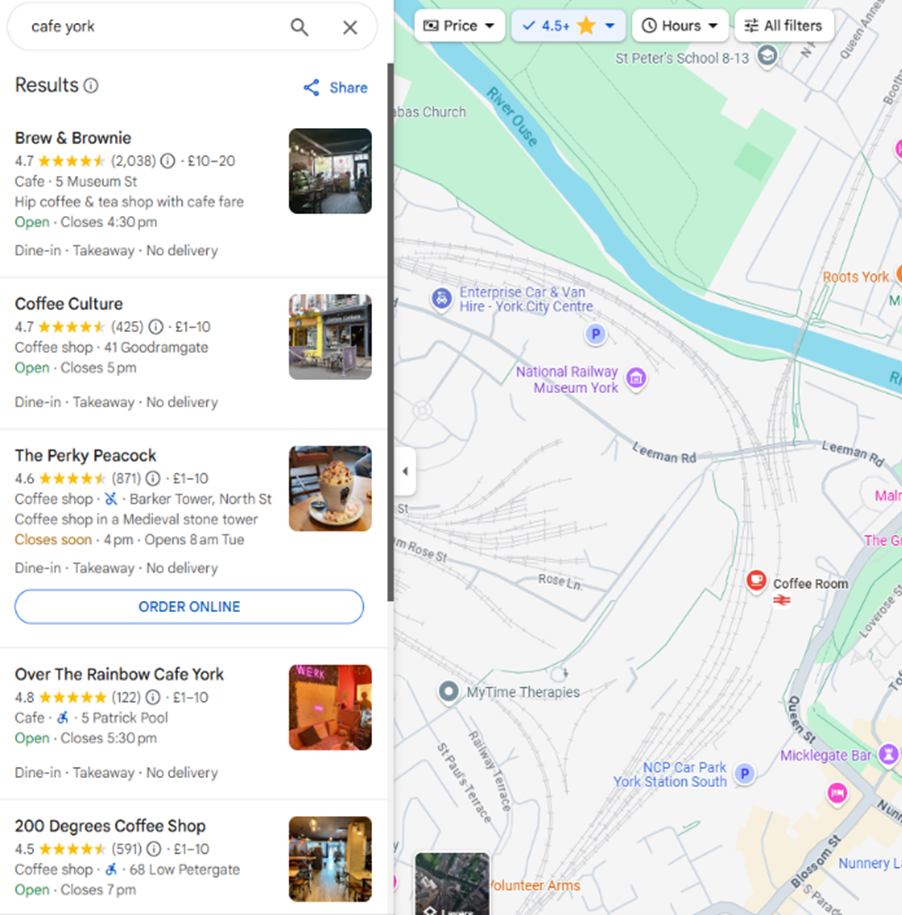
Ultimately, it’s all well and good showing up on the first page of Google SERPs, but what does that entry say about your business? Would a potential customer take away a positive message from that search result? That’s what Online Reputation Management is all about.
The Importance Of Search Engine Reputation Management
Since we’ve covered what ORM is and how it works with SEO, you’ve likely got a few inklings as to the importance of reputation management in the context of search engines. Nonetheless, let’s break it down just a touch further to really drive the point home.
First Impressions Happen Through Search
You’ve heard it before, but you really do only get one chance at a first impression. If your business is online, it’s likely that a significant proportion of customers form their first opinions based on what comes up on the SERP pages, which is even more the case for e-commerce businesses. Plus, as Google revealed in a consumer insight study, 70% of all consumer journeys involve a Google touchpoint, so even if it’s not the first impression, search likely will impact how your business is seen at some point down the line.
So, what impression do you want to make? Unless it’s negative or at best, indifferent, ORM should be part of your digital marketing strategy.
Trust Can Be Built (Or Broken) On Responses
Reviews are important for a number of reasons, not the least boosting SEO and providing material for future marketing campaigns; but perhaps the most important reason of all is their ability to build trust, credibility, and respect. With 85% of consumers trusting online reviews as much as personal recommendations, the power of the written word has never been greater. And it doesn’t end at what the consumer has to say: 45% of potential consumers are more likely to visit a business if it responds to negative reviews.
The Snowball Effect Is Real
In case you were in any doubt, ‘fake’ (and negative) news spreads fast. For instance, take the Starbucks fake ‘Black History Month’ coupon scandal in 2018, which quickly went viral on platforms like Facebook and Twitter before eventually reaching mainstream media. The challenge for Starbucks was twofold in that it had the potential to damage brand reputation for inclusivity as well as causing more logistical problems. Depending on the scale of your business, it’s unlikely that things will get that far, but it is vital to keep an eye on what is being said about your brand before it spirals into something bigger and beyond control. A silver lining though: you can use the snowball nature of social media to your advantage to promote positive messages too!
Reputation Affects Revenue
If we’re being blunt about it, what it all really comes down to is that reputation affects revenue. If you are constantly missing out on potential customers because of a negative news story or review, then you’re unlikely to be able to manage and maintain any kind of growth. Put another way, if your online reputation is poor, you’ll lose customers, and in turn, revenue, but if your online reputation is in good shape, then you’re on track to get more customers or clients – ORM makes sure your business follows the latter.

6 Tips For Effective Online Reputation Management And SEO
We’ve covered the what and the why, but how can you go about improving your online reputation, especially in an SEO context? Well, we’ve got 6 key tips to get you started…
1. Drive Reviews (And Respond)
At the heart of Online Reputation Management and SEO is the review. Trusted by potential consumers for a taste of their future experience with your business, it’s vital that you don’t overlook reviews, especially if there’s a few negative commenters in the mix. Plus, they can be integral for building your Google Seller Ratings, a starred representation of all your reviews that can be displayed beneath your business on SERPs.
Whilst it can be frustrating and difficult to deal with negative reviews, a response is always better than leaving it to speak for itself. That way, you can control the narrative whilst demonstrating what your business is all about. Remain professional, acknowledge their experience, and ensure you make the reviewer feel seen and heard. It’s worth it – 64% of global consumers prefer to buy from a responsive company over a perfect one.
But responding to reviews is one thing, what if you just don’t have any (or at least any that are up to date)? The simple answer is to ask! Whether that’s sharing a QR code after checkout, or a follow-up email requesting feedback, ensure that you make it quick and easy for customers to complete the process. It can also help to explain why reviews matter to ensure that customers understand how valuable their feedback can be.
2. Build Backlinks With Online PR
Another way to establish your site as authoritative, and therefore increase your online reputation, is to build your backlink profile. Backlinks are simply any link on another website that leads to yours. They are incredibly useful for not only directing traffic to your content but also establishing a vote of confidence in the eyes of search engines, working wonders for SEO efforts.
Backlink acquisition can take many forms, from directory listings to offering your site as an alternative to broken links. Guest posts are a particularly useful starting point, typically involving writing an article for another site that contains your chosen link. Whichever method you choose, ensure that your backlinks remain authentic and relevant to whoever might come across them!
3. Monitor Potential Brand Threats
Monitoring for reputational threats is a crucial part of a strong online reputation. This doesn’t just mean reacting when something goes wrong, rather you should aim to stay ahead of any issues before they gain momentum. If you stay alert to any negative reviews, critical posts, or a general shift in public sentiment, then you’ll be able to make sure that small sparks don’t turn into a full-blown wildfire.
The easiest way to monitor threats is to invest in a tool like SEMrush’s Brand Monitoring app to track mentions of your business across social media, forums, and review sites. You’ll be able to set up alerts for your name (and your competitors!), certain products, and keywords so you can keep your finger on the pulse of what’s being said and tackle any issues promptly.
4. Address Concerns Through Your Content
Let’s say you’ve done a great job at monitoring your online reputation, and you’ve come across a growing concern around your business. One of the best things you can do is to address said concern through your own high-quality content, whether that’s compelling copy on your site, or a social media post setting the record straight. That way, ‘risky’ search queries can provide an excellent opportunity to get your content higher up the SERPs whilst also allowing readers to get their answer straight from the horse’s mouth.
Similarly, you may have come across ‘People Also Asked’ search prompts. These lists of suggested searches appear on Google amongst the listings on a result page and can be great snapshots of what sentiment people are approaching a certain topic, or indeed business, from. Take for example, the PAA search prompts under a search for ‘Nestlé’.
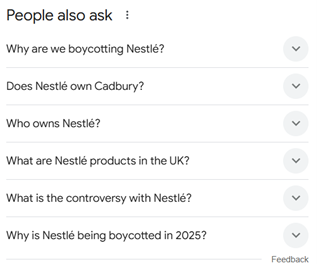
To address any growing controversy, Nestlé could produce a page on their own site to explain any steps they may have taken since the beginning of these conversations, thereby accepting accountability whilst also keeping control of the situation. They could also approach any authors of pages that discuss the controversy, asking for them to update their information.
5. Celebrate The Good
Enough negativity – let’s reflect on how to maximise the good. It’s as simple as talking about it. It could be ensuring that you consistently respond to positive reviews, offering a thanks and a personalised message. Or maybe it could be writing a blog post to celebrate a positive news story about your company. Sharing wins on social media can also be an excellent option, particularly as it costs nothing to get started and can have a substantial impact on your SEO ratings. To put it simply, it’s no use taking so much time to address the negative if there’s nothing positive out there to convince potential consumers otherwise!
6. Consider Google Guaranteed
If you’re a local business, getting Google Guaranteed is a smart move. The little green badge next to your name in Google’s Local Services Ads speaks volumes to potential customers, showing that your business has been thoroughly checked and is backed by Google.
Whilst it can take a bit of work to obtain (background checks, licence verification, and insurance requirements), when you’re done Google will quite literally guarantee your work – up to a maximum of £1,500. In local markets where trust and reputation are everything, it can turn hesitant searchers into confident customers.
A Final Word
In the ever-changing online world, what people find on search matters just as much as if they find you at all, which is why ORM and SEO aren’t just complementary, but inseparable.
Whether you’re a small local business or growing e-commerce brand, your online reputation is a living, breathing extension of your business. So, if you’re looking to boost your local SEO, clean up your online image, or take control of your digital presence, our ‘hive’ of experts are ready to help.
Let’s chat and create something ‘buzzworthy’ together!