Two Google updates recently sent ripples through the SEO world: one aimed at spam, the other quietly turning off a tool relied on by SEO platforms. It’s the culprit behind a widespread drop in website impressions since mid-September, and a source of panic among businesses operating online. Here’s what’s changed, how to tell if you’re affected, and what (if anything) you should actually do about it.
Spoilers: While changes to your website traffic may look drastic on the face of it, it’s not quite as bad as the clickbait SEOs make it out to be.
Skip to:
- Google’s Anti-Spam Update (August 2025)
- The “&num=100” Update
- When (And If) You Should Act
- Final Thoughts: Don’t Chase the Algorithm
Google’s Anti-Spam Update August 2025

What is it?
A planned Google update (rolled out 26 August-22 September 2025) and the first Anti-Spam update since 2024. This spam crackdown has impacted sites of all sizes – catalysing drops in site impressions around the 40%-60% mark for some of our clients at beefound, and even higher in other cases that have been reported.
Google’s systems find 40 billion spammy pages every day. This new update to the Search algorithm is simply an extension of their ongoing work – designed to clean up the SERPs, banish thin and spammy content (especially AI slop) and deliver higher-quality results to the user, protecting them from misinformation and manipulation.
Ultimately, Google’s core mission hasn’t changed here: they’re still centring value, it’s just that this ‘value’ is now derived from sites with clear authorship, demonstrable topical authority, and genuinely helpful, unique content based on EEAT. If that sounds familiar, then you’re doing something right, and best of all, you can get ahead as other businesses panic – but put a pin in that for now.
What does Google Say?
Around 9pm Pacific time, Google revealed their latest algorithmic development to the world via their socials, posting this on LinkedIn:
The so-called August 2025 spam update would turn out to be global, with every language and country impacted. Unlike previous updates, Google declined to share the specifics of what they were targeting – to the frustration of many businesses operating online.
Luckliy, this isn’t our first rodeo; with years of experience to fall back on, our worker bees could work out what Google was going after…
- Scaled content abuse: the mass production of (human-written and AI generated) content designed solely to rank or manipulate SERPs.
- Example: sites that engage in content farming and who only publish copy-and-paste, thin, keyword-stuffed, unoriginal content.
- Site reputation abuse: Piggybacking off the authority of trusted third-party sites to exploit the host site’s ranking signals
- Example: A third-party hosting casino reviews on a high domain authority educational site.
- Expired Domain Abuse: Repurposing expired domains to host low-quality, spammy content to game the ranking system.
- Example: An expired, high-traffic travel blog being purchased and turned into a crypto site.
This is by no means exhaustive; all the classic SEO spam tactics (cloaking, keyword stuffing, etc.) are being annihilated by the new update, making the web a much cleaner place.
Who got hit?
With those spam tactics in mind, the biggest hits we’ve personally seen are on websites that…
- Pump out AI-generated content to rank, without any human oversight
- List loads of product pages with little-to-no information and were ranking solely because of the wider domain’s standing
- Rewrite content already out there, without adding anything interesting, unique or insightful
- Publish for rankings, not readers.
Basically, websites that have either been trying to take shortcuts, cheat the system, and/or fail to offer anything of value to the user – these are the ones that likely got downgraded in the SERPs.
How to spot it
Any site hit by this update will notice sliding rankings, substantially fewer clicks and a drop in impressions.
But if your page 1 rankings and click-throughs are holding steady (even with fewer impressions), it’s probably not the spam update causing trouble.

The &num=100 Update
WTF is “&num=100”?!
“&num=100” probably means absolutely nothing to you… After all, it looks like a cat just took a nap on your keyboard. Allow us to explain:
&num=100 is simply a query parameter you could once use to see 100 search results on a single page.
It’s not particularly useful for the general Google user. However, this is how the best SEO tools, like Semrush and Ahrefs, and a plethora of bots used to check rankings efficiently and more cheaply. Google quietly pulled the plug for this method in mid-September.
Who did it affect?
Good news for most business owners: the death of &num=100 likely hasn’t touched you at all. In fact, most sites are now seeing cleaner data in Search Console, so fewer bot impressions inflating stats on page 2 and beyond.
On the flipside, SEO tool developers are having a hard time of it. Since they can no longer grab the top 100 search results in one go, they now need to run more queries – 10x more, in some cases! Not ideal in terms of cost-efficiency or the speed of these tools.
What to look out for
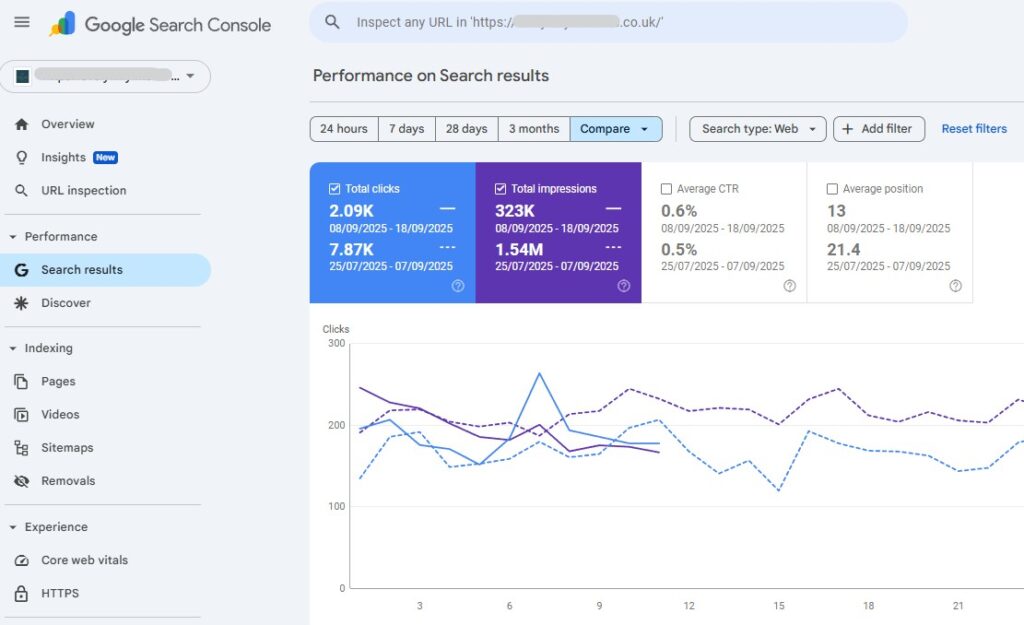
Launch Google Search Console and look at a custom period between the 8th & 13th September 2025 and compare that with the previous period. Select “clicks”, “impressions” and “position” from the chart. What you’ll likely see:
- Impressions have fallen dramatically – with beefound.agency clients, I’ve seen anywhere from 20-50% as a result of this update. But wider analyses by other SEOs, like Tyler Gargula, have shown 77% of sites have lost keyword visibility since
&num=100was axed. - Average position has increased significantly
- Clicks have been stable – If clicks have gone down, consider external factors, like seasonality, as to why this might have happened.
The important thing to remember is not to panic. This update will likely have zero impact on your business; the recent Google update aims to clean up bot and scraper traffic, leaving only real human impressions and fewer “fake” views.
What’s more it follows a precedent set in recent years: the decoupling of clicks and impressions – a phenomenon wherein an increase in impressions is no longer matched with an increase in clicks.
When to Act
If your rankings slid and your clicks have tanked between the end of August and end of September 2025, you probably need to act. It means your site’s rankings have likely been impacted by the duo of new updates.
What to do (and what not to do!)
Don’t like what you see in Google Search Console? Then it’s time to act. Here are a handful of short-term and longer-term fixes that will set you on the right path. Think of it as an opportunity: if you react fast, you can win big while your competitors are still running around like headless chickens.
Short-term fixes
- Audit your site content and remove any low-quality, duplicate or automatically-generated content
- Audit your backlinks and disavow any spammy links
- Wait patiently and monitor any changes
Longer-term solutions
As the beefound.agency team learned recently, the long-term solution is primarily a change in perspective, a paradigm shift, if you will.
Understand that SEO is more about quality, utility and trust – not inflating vanity metrics like impressions and keyword rankings. So, when creating new content:
- Make sure your pages have enough unique and useful content (I’m looking at your, e-commerce store owner with a gazillion products imported from Ali Express!)
- Follow E-E-A-T guidelines
- Avoid mass production of content
- Talk from experience and include real-life examples to back up your points, or reference case studies where appropriate
- Link to authoritative sites that back up your points
- Don’t write to a word count, create as much as is useful, don’t pad it out unnecessarily!
- Write an author bio – tell readers why they should listen to you
- If you’re writing something that’s been done before, give your take on it, add value
- Use other media – videos, infographics, charts to help add value.
- Link to your internal pages, where useful
- Write your content in a clean, clear and easily digestible format (headings, bullet point lists and shorter paragraphs are parsable for both humans and AI)
Final thoughts on Google’s 2025 Updates
This isn’t the first, and it won’t be last Google update.
From keyword stuffing in white text on white backgrounds to dodgy link farms and spun content, SEO history is full of people trying to game the system. And every single time, Google catches up.
The lesson? Simple: create for humans, not search engines.
Be useful. Be original. Be worth clicking. If your content genuinely helps users, Google has no reason to knock you down. In fact, you’ll probably rise.