The brutally honest truth of being a services business in 2026 is that, well, it’s brutal. More leads ≠ more sales. The age-old tactic of optimising sales volume to amplify profit is losing its touch. Neither can you blindly scale your marketing activities without first taking a good hard look at your foundation.
This is why the top brands never preoccupy themselves with merely chasing leads, instead they create an irresistible lead acquisition system. A pre-sold client funnel that lures in the prospects you actually want to work with: purchase-ready folks who trust you, understand your value and are open to convert before the sales call rolls around.
But what exactly is lead acquisition? And isn’t that the same as ‘lead generation’?
Spoiler alert: they’re subtly different, yet they need to be aligned around one crucial metric. And that’s customer lifetime value (CLV)…buuut I’m getting ahead of myself. First, let’s walk things back to the basics.
Skip to:
Back to square one: what is lead acquisition?
Time to do away with the confusion. What is lead acquisition, what does it involve, and how does it differ from your garden variety lead generation? All good questions.
Lead acquisition is a process of pollination. You set up streamlined systems to spot, attract, capture, qualify and organise high impact leads in your sales pipeline, ready for the final conversions. (SaaS subscriptions, trade quotes, sales calls, consultations, and so on…).
Dumbed down, it’s about turning the right visitors into genuine sales opportunities: long-term, repeat buyers/subscribers who won’t ditch you when your lesser competitors offer a discount.
Crack the conversion code, and you’ll crush customer churn, push down cost per lead, and bag yourself a loyal customer base who stick around for you, not just a price tag or convenience. Needless to say, lead acquisition can be a major profit engine for your business, laying the path for sustainable growth.
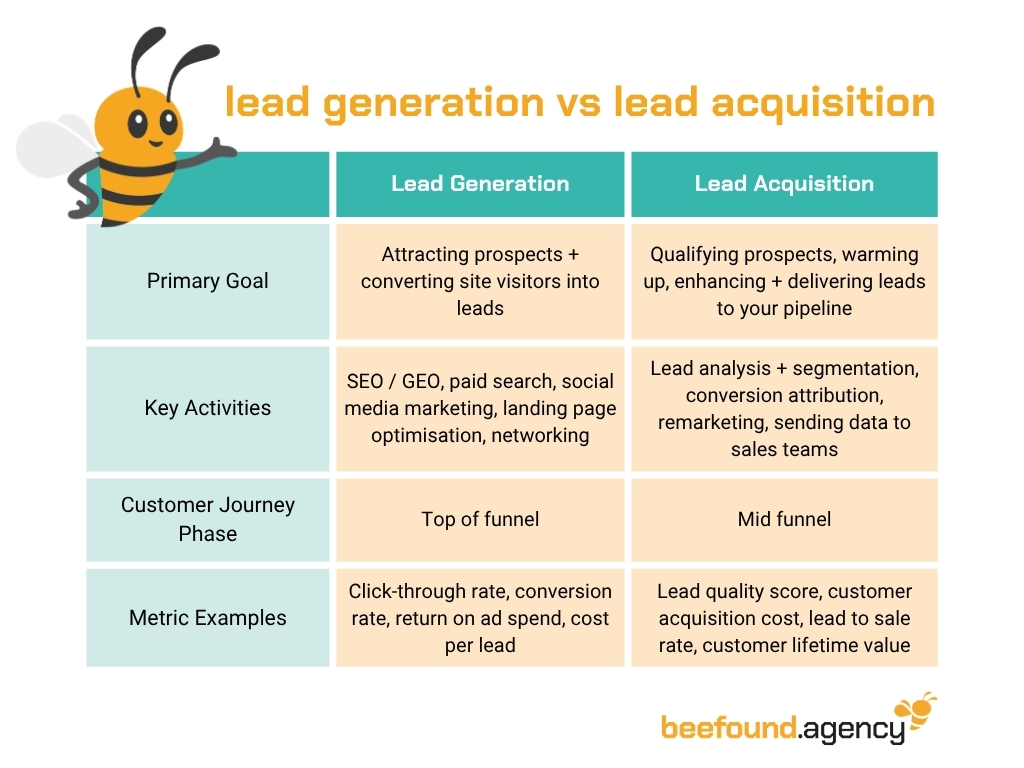
Let’s Bust Some Myths: lead acquisition vs lead generation
You’ve probably heard marketers use the terms ‘lead generation’, and ‘lead acquisition’ interchangeably – hell, even I’ve fallen into that trap! However, make no mistake, the pair are distinct disciplines which straddle different parts of the customer journey (even if some overlap exists). So, let’s compare them.
Lead generation precedes the acquisition phase. It’s all about attracting top-of-the-funnel prospects who might be open to your offering and swayed by your brand story. Oftentimes, the bulk of the work lies in the realm of inbound marketing tactics, like SEO/GEO (Generative Engine Optimisation) or a targeted Google ads campaign. In other words, allowing your brand to ‘bee’ found online.
Lead acquisition, however, is the next step along. Here, marketers switch pace, moving from a pure focus on volume to quality. That is, it’s all about sifting through the prospects you’ve enticed to find the ones genuinely worth your time. How? Through a process of lead analysis, qualification, remarketing and nurturing – everything you need to nudge them further down the customer funnel.
This way, your budget works much smarter for your business. No wasted spend on dead-end leads and bags of time freed up for those deal-clinching tasks. Naturally, this setup ends up paying for itself in the long haul.
Why lead acquisition is kind of a big deal
The importance of lead acquisition is on par with that of your deal-closers. If anything, it’s even more crucial, because without a consistent feed of qualified, top-notch leads, you’d have no one serious to pitch to.
Call me biased, but if you’re not earnestly invested in it, you’re letting the most potent sales opportunities slip the net. Don’t just take it from me, though. Here are the facts.
- Lead acquisition means attracting better quality leads, not just more – and marketing teams know it; in 2026, 39% are actively prioritising lead quality and marketing-qualified leads (MQLs) over other performance metrics.
- It’s a marketing ROI elevator, ensuring that PPC spend and content marketing budgets go towards those who are most likely to become customers.
- You land higher quality enquiries, the sorts you’d fight, rather than settle, for. Large deals, longer contracts and repeat business you can rely on for sustained growth.
- Your sales pipeline becomes healthier and faster, since it’s qualified prospects you’re dealing with. Sales teams no longer have to go against the clock to filter out junk enquiries – that’s more time speaking with people who are ready to buy.
- Lead acquisition aligns with the future of lead gen. The contemporary consumer is more informed than ever. Rarely, do they speak to a business first; they research, find advice, and compare options across numerous touchpoints, from socials to AI chatbots. And with the latter, leads are arriving with higher intent.
- Ultimately, lead acquisition slashes inefficiencies and stops any leaking budget.
And what exactly makes a ‘quality’ lead?
I’ve hammered it home: an ethos of quality over quantity sits at the heart of lead acquisition. But how exactly does one define ‘quality’? Put succinctly, it takes looking beyond the vanity metrics to home in on the data that matters.
The expanded edition is that service providers deal with a very specific type of customer, with niche requirements, pain points nicher still, and high expectations of services. These types of businesses can’t afford to settle for a generalised customer base, because complex subscription models and longer lead times demand truly invested clients who will pay more upfront and stick around for the long haul.
Which is why many enterprises and small biz folk I’ve spoken to are pivoting towards customer lifetime value (CLV). This targeted approach is foregrounded in the idea that CLV recognises that customers are valuable beyond their first purchase and are wells of potential for the long-term.
As top dogs at Google, Lauren Adams and Dan Taylor, argue “if the Pareto principle, also known as the 80/20 rule, holds true for your business, it means that 80% of your revenue is being generated by 20% of your customers”. Yes, a retention-focused approach should inform your broader customer acquisition strategy.
How the leading brands measure success
- Customer Lifetime Value
- Lead quality and MQLs
- Lead-to-Customer Conversion Rate
- Return on Marketing Investment, including Return On Ad Spend
- Cost Per Lead
- Lead to Sale Rate
- Customer Acquisition Cost
By zeroing in on these KPIs, you’ll know exactly where to optimise, because it shows exactly where your spend is paying off. Concentrate your energy on the areas with the largest performance gaps and you’re onto a winner.
Okay, cool! But what does the lead acquisition process look like?
Granted, no two businesses are identical, so I don’t expect every brand to follow the same route to customer acquisition. But the core pillars remain.
Below is an overarching framework that gets results. Typically, it incorporates a series of phases: audience research, conversion optimisation, mapping lead sources, capturing and crunching the data, then passing on those piping hot leads onto sales. And, of course, there’s tons of iteration and improvement baked in.
Understanding your audience…
First-party data ought to be foundational to your strategy. Because to build trust with your audience, you first have to know them.
Who are they? What friction are they rubbing up against? What do they value? Do you really, I mean really, understand their pain points?
You don’t have to be Professor X to make them feel seen; invest in high-quality, ethical data attribution and visitor tracking software. Do some A/B testing. Actively listen to customer feedback and reflect their own words. And you’ll uncover exactly what moves them to buy.
Plug these details into your CRM, or wherever your sales data lives, and you can keep the customer experience consistent across departments.
…And attract the most valuable members
In my experience, many well-intentioned business folks get too hung up on trying to convert every new buyer into a high spender as opposed to acquiring customers with deep pockets from the get-go.
Instead, I recommend identifying the qualities of those audience segments most likely to exhibit high CLV. Attributes along the lines of common interests, user behaviour, demographics and their path to discovery. This can inform the way you delegate tasks, giving a generous slice to the nurturing the actions which are most profitable.
Honing your conversion infrastructure
With your VIP list of ideal clients and an understanding of the conditions needed to attract them, you can return to your lead generation channels and bolster their performance.
As this is opening such a gargantuan can of worms, this is going to be breezy, so I recommend poking around on the beefound blog for deeper insights and practical advice.
- Make sure ad campaigns are tightly managed and harness the tools available to you. Performance Max is a powerful place to start.
- Upgrade your website design, so it hinges on the user experience. That means prompt loading speeds, mobile-compatibility, accessible fonts and imagery, transparent pricing and clear information about your services, story and USP.
- Optimise your data collection methods. From sign up form copy down the number of boxes, they should be precisely tailored to the audience for a frictionless experience.
- Lead magnets, such as blog posts, checklists, cheat sheets and decision guides, should all be SEO optimised and retrievable for AI search.
- Sweeten the deal by implementing social proof; truly, reviews and testimonials go such a long way.
Capturing details & data
Every lead has to start somewhere. Whether it’s a contact form, quote request, newsletter sign-up or downloadable guide, make it ridiculously easy for people to raise their hand. The fewer barriers between a prospect and your business, the better your chances of turning interest into action.
Just as importantly, make sure you’re collecting the right information. Ask for enough detail to qualify the lead without overwhelming them with endless form fields. It’s a balancing act, but one that’s well worth getting right.
Behind the scenes, accurate tracking is what ties the whole acquisition process together. While traditional browser-side tracking still has its place, server-side tracking is quickly becoming the gold standard. Using one or a mix of data attribution tools like WhatConverts, Plausible Analytics, Cometly or Matomo you get a neat privacy workaround and you can feed the results directly into Google Ads to supercharge the targeting. I’d also recommend checking out all the little AI-powered add-ons – the features are very sophisticated!
Leads analysis & segmentation
This stage is pretty self-explanatory. With plenty of data at your disposal, you can go about scoring and prioritising leads under the models of your choice, be they…
- Demographic: Scoring your leads based on factors such as age, location, company size, job title or industry to filter the best fits.
- Behavioural: A focus on the specific actions or sequence of actions a lead has taken and comparing it against historical trends among sales converted leads.
- Predictive: Scoring leads dynamically using machine learning technology.
- Negative: Whittle out the leads with undesirable behaviours or characteristics, for instance, their if budget is too low for your services or they show signs of disengagement / a misalignment of intent like visiting a careers page.
Leads Nurturing
When leads have one foot in the door, don’t neglect them! This is the time to build relationships with soon-to-be customers, so they feel that their needs are accommodated and that your brand is one they can trust.
To encourage action, serve up relevant, tailored messages based on their past actions. Did they download an eBook? Remind them. Have they completed a form? A little thank you wouldn’t go amiss. These sorts of marketing communications are ripe for automation, particularly if you can feed these email sequences into your CRM.
Simultaneously, maintain real estate in their brain. Remarketing ads are an effective tool to this end; with the exposure advantage in your corner, the next time your clients reach a conversion point, they’ll already be suitably primed for the interaction.
Optimise, Optimise, Optimise
It’s a cliché, but it’s true: no form of marketing is ‘one and done’, ‘a tick box exercise’, ‘set and forget. [Insert your favourite idiom here].
To reap concrete gains and keep up the pace with the ever-changing market we find ourselves in, continual improvement must be at the top of the agenda.
Whether that’s fine-tuning your messaging, improving response times, increasing investment in your business blog and other lead magnets, or finally getting a specialist at the helm of your PPC, there’s always room for improvement, I promise you.
Handing it over to sales
Yep, that’s it. With all of the groundwork covered, you can pass over those highly qualified leads to your sales experts to work their magic on the customer. If you’ve done your job well, it’ll only take a gentle nudge.
Conclusion: don’t wing it, let the data guide you
To pick out a through line: it’s the data that differentiates you. Without a clear window into your leads, audience demographics and how your strategy is performing in real-time, you’re essentially marketing in the dark. Missing out on vital pivot points.
So, if there’s anything to put your budget behind, it’s a decent data attribution tool that can shine a light on your site visitors’ behaviours – or, at the very least, a marketing crew who can do the hard graft for you.
To get your mitts on deep expertise, check out our lead generation services, or directly get in touch with the hive at beefound.agency.