Dealing with negative reviews, doing your tax returns, navigating the intricacies of social media – each of these could easily chalk up to the bane of your existence as a small business owner, but one thing really takes the cake. And that’s abandoned baskets.
Tantalisingly close to going through, those forgotten baskets build you up before bringing you back down. The disappointment is real, or if it’s a high-margin purchase, the despair. So, what can you do about it?
It turns out, quite a lot. Which is exactly why we’ve created this comprehensive guide; with our insights and a few quick fixes to your website, it’s relatively simple to claw back those all-important orders and, of course, turn the additional sales into an increased ROI. Without further ado, let’s dive into the details.
Skip to:
- What is basket abandonment?
- Why it happens
- What it means for your business
- What you can do about it
- How to measure the impact of your strategy
First up, let’s get everyone on the same page: what’s basket abandonment?
Basket abandonment is a simple (and probably familiar) concept; after all, it affects virtually all brands that have an online presence, with industry benchmarks showing an average rate of 70% worldwide. That’s 3 in 10 potential sales.
It’s essentially when customers fail to complete the checkout process on a given site, leaving the item or items sitting in the basket forgotten.
As you can imagine, this is pretty much a daily occurrence in the e-commerce space, but fortunately, there are established strategies for recovering the goods and, thus, bringing your profit back up to a healthier level. First, though, let’s talk a bit about the underlying reasons why people don’t complete their purchases in the first place.
Why it happens
User behaviour is complex, and there are many reasons why would-be shoppers do what they do. Fortunately, there’s masses of data on this topic, thanks to dedicated researchers in the field.
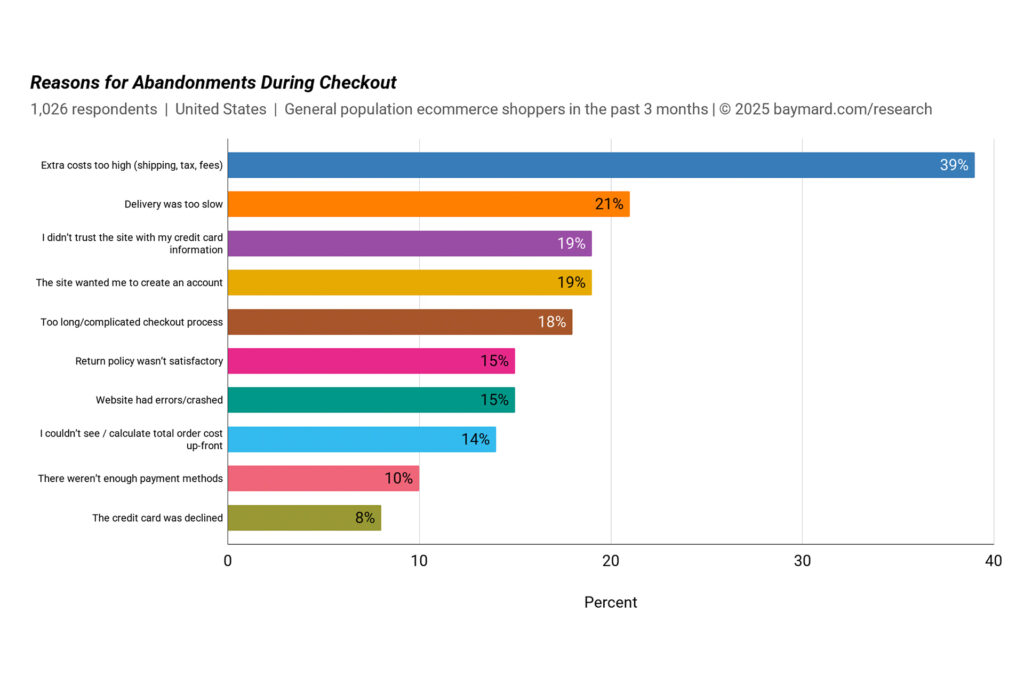
Instead of rehashing dense papers, allow us to give you a brief overview of the main reasons for abandonment at checkout based on the findings of the Baynard Institute’s 2025 survey, plus some fascinating insights from Statista.
Here’s a breakdown in order of reported frequency:
- Just browsing / not ready to buy – 43%
- Additional or hidden fees (think shipping, tax or processing fees) – 39%
- Slow delivery – 21%
- Couldn’t trust the site with credit card details – 19%
- Account creation – 19%
- A lengthy or overly complicated checkout process – 18%
- Unsatisfactory returns policy – 15%
- Website errors – 15%
- No or ambiguous total order cost up-front – 14%
- Lack of payment methods – 10%
- Credit card declined – 8%
* Note that “just browsing / not ready to buy” has been segmented out of the chart.
On top of these general reasons, there are also some psychological culprits. Take, for instance, decision fatigue, which makes choosing between products a longer, more difficult process. Well, the data suggests that the longer customers take to decide, the higher the cart abandonment rate. This is especially true of high-margin purchases like jewellery (84.49%), home furnishing (90.50%) and automotives (85.97%). Other insights reveal that even small factors like device type can make a difference, with users being more likely to jump ship on mobile compared to desktop.
What it means for your business
Basket abandonment isn’t anything to worry about in isolation, but over time, it can cost your business serious money; after all, that’s swathes of potential customers failing to spend or, worse, choosing the products of a competitor over your own, like 26% of Brits do. To put it into perspective, this problem causes e-commerce brands a staggering $18 billion a year in revenue terms, according to Forrester research. That figure’s not to be scoffed at!
I’m sorry to say there are other downsides, too. Unfortunately, abandoned baskets also mean inflated customer acquisition costs. As you pour more budget and energy into marketing schemes like paid ads and socials but fail to focus on how to strategically convert those leads, your methods aren’t cost-effective, plain and simple.
The last thing of note is the increased retargeting costs tied up with recovering those lost sales. It stands to reason that the higher the abandonment rate, the greater your budget needs to be – and this is all whilst customer loyalty opportunities are slipping you by!

The important bit: What you can do about it
It was clear on the face of it: to boost your online sales and stop being a victim of a mountain of abandoned baskets, you’ve got to cut the number of potential customers that keep you hanging at the checkout. Here are some tried and tested strategies to learn, give a go, and optimise with practice.
1. Make the check-out experience smoother
Given the tea we spilt about basket abandonment reasons, it’s without a doubt that checkout optimisation should be at the top of your priorities list. After all, checkout flows with tons of form fields, lots of steps, or a confusing layout aren’t just annoying to deal with on the consumer’s part, but they actively harm your sales potential. To turn things around, keep the user interface simple, accessible, and sustainable design-wise. Visual clutter is distracting, so additional pop-ups, links and icons should be kept to a minimum.
2. Improve your website speed & check for errors
Since website errors have such a drastic effect on sales, it’s important to get your digital shopfront in order, so to speak. We have a whole guide to improving your website applicable to e-commerce brands, but to start with, make sure you tackle website errors and minimise crashes. Here, it’s a good idea to run regular audits to ensure everything’s ticking along, especially since some errors might not be noticeable manually until weeks have passed – meaning they could affect an untold number of customers!
3. Streamline the user journey
Streamlining the user journey essentially boils down to removing friction and building trust from product discovery to checkout. Every step of the process should be seamless, and that means creating a consistent multichannel retail experience that communicates a persistent brand identity, values and, ultimately, customer experience.
4. Be transparent about pricing
No one likes to be misled. As such, be upfront about your pricing from the get-go, providing shipping costs, VAT and extra fees as early as possible. You could even build cost calculators for bulk products to set customer expectations and maintain your transparency. This establishes trust and authority, which dispels any negative perceptions of your brand as inconvenient or unreliable.
5. Provide more payment & delivery options
In today’s e-commerce sector, more options are always better – for the customer, but for businesses too, as it often translates into greater sales. Shoppers expect a smooth and convenient checkout experience, so limited payment and delivery options tend to stall purchases and may even contribute towards a loss of trust in your brand.
6. Be more proactive with customer support
Did you know that you can prevent lost sales before customers even reach the checkout? With a live chat on the product or basket page, it’s relatively easy to catch hesitations by answering common questions like, “What’s your return policy?” Not only are you reducing indecision and demonstrating supportiveness, but in the case of a declined card, an assistant can troubleshoot the issue in real-time.
7. Send email reminders with incentives
This is the go-to abandoned basket strategy, and for good reason: basket recovery emails have high levels of engagement and can be really impactful on conversions. According to data gathered by Klaviyo, who crunched the numbers on millions of examples, campaigns with multiple emails outperform those that sent a single one, driving up open and click-through rates.
You can optimise even further by using personalisation techniques, such as including customer first names in the subject line, persuasive copy, hard-hitting reviews, unique discount codes and ‘other products you might like’ suggestions.
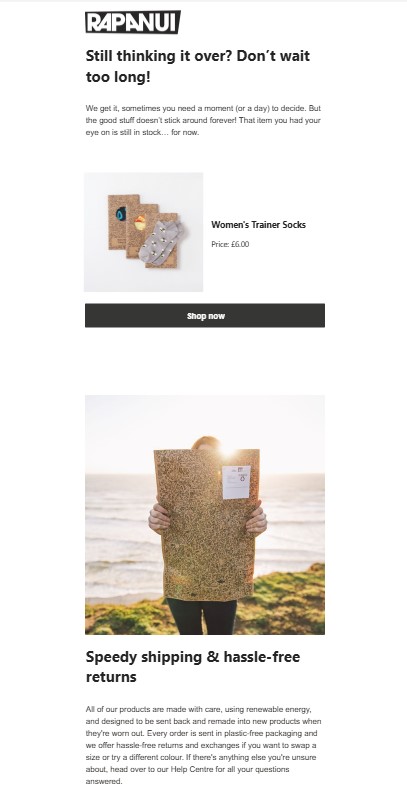
Abandoned basket email examples
To give you a better idea of what we’re talking about, here’s an example I came face-to-face with while I was shopping around for some new socks. (See? It happens to even the best of us!)
8. Launch retargeting ads
Retargeting ads are a powerful tool at your disposal, especially if we call back to that 27% stat about customers abandoning baskets for competitor products. Now to impart you with a new one – MotoCMS reports that they reduce abandoned baskets by 6.5% and increase sales by 20%. Sounds enticing, right?
9. Try out abandoned cart software
Simply put, abandoned cart software is exactly what it sounds like: technology designed to recover lost sales. Much of this relates to email automation and pop-ups that appear when users show intent to exit the page, but the beauty of these tools is that many of the big players, like Klaviyo and Omnisend, integrate with reams of e-commerce platforms.
10. Optimise content & messaging for conversions
Even if the majority of your missed sales come down to customers feeling unready to buy or stuck in ‘research mode’, all is not lost. We see ourselves as glass-half-full kind of people (or in this case, basket-half-full), and that means seeing opportunities despite the challenges.
In this case, the positive is that there’s always something you can do to make your offering more appealing, whether that’s investing in higher-quality product photography, optimising category descriptions for SEO, making more of an effort to manage your brand reputation or going after a higher number of reviews. Stay competitive, keep refining over time, and you’ll see better returns.

How to measure the impact of your abandoned cart strategy
It’s all well and good to implement some of the strategies we’ve outlined above, but if you aren’t tracking their impact, how are you going to know whether they’re working? Confirming which marketing channels bring the highest ROI will allow you to allocate budget where it matters most, attracting those who are most likely to convert into customers and even repeat customers. Here’s how to get started.
Analytics & Tracking Software
To start off, you’ll need the right software to visualise the data concerning who is visiting your site, what they’re doing there and how many baskets are being left unbought.
Visitor tracking tools like Google Analytics and Google Search Console are crucial for parsing your audience’s behaviour, while attribution software can illuminate the paths users took to reach your site. Here, server-side tracking is a real asset, particularly as it side-steps the accuracy issues that first-party, cookie-based alternatives experience.
This said, if new tools overwhelm you, your first port of call should be to check the tracking capabilities of your current website. The best e-commerce selling platforms offer baked-in features or extensions for basket tracking, so you can see what’s going on.
Benchmark, benchmark, benchmark
Armed with the right tools, you can now check your baseline basket abandonment rate, not forgetting to segment your findings by device type and other important factors. From this figure, you can set realistic goals, like reducing the rate by 5% in 3 months. You might also want to do some homework on industry benchmarks as a point of comparison. Once the timeframe for your objectives has been surpassed, go back, reanalyse and optimise what works and ditch what doesn’t.
A/B testing
Another way to remove the guesswork from the equation and make sure you’re not just ‘winging it’ is to trial a period of A/B testing. This means running two different but similar campaigns and comparing results. This way, it’s much easier to pinpoint the hardest-hitting tactics, refine your copy and improve your practice overall.
From abandoned basket, to cart recovery
In the end, your abandoned baskets needn’t become a basket case when you can turn them into an opportunity. The stats don’t lie; businesses that invest in effective basket recovery strategies see higher conversions and generally earn more sales.
The only thing that’s left is to unpack your own website’s basket abandonment. Why are potential customers leaving you hanging? For an expert opinion on all things organic content and website optimisation, chat to our friendly worker bees. We’ll prime your store for conversions and help you recover revenue you thought you lost.