SEO results come from understanding the different types of backlinks. Focus on quality, relevance, and transparency, and your backlink profile will help you build lasting authority and drive organic growth.
Backlinks are one of the building blocks of SEO outreach, but they aren’t all created equal. Whether you run a professional service, e-commerce store, a SaaS platform, or something else, understanding the different types of backlinks can be the difference between page one and a website lost at sea.
This article will give you everything you need to become a backlink legend. From what they are to the different types, how to use them, and everything else you need to know, we’ll give you the tools to master this fundamental element of SEO.
Skip to:
- What are backlinks?
- The different kinds of backlinks and why they matter
- Backlinks by placement
- Which types of backlinks work best?
- The role of AI search
What are backlinks?
Backlinks are hyperlinks going from one website to another. The more quality backlinks your website has, the more trustworthy it appears to search engines. This contributes to higher rankings due to more perceived authority. Sounds simple, but the key here is quality: fewer links from credible, relevant websites are worth more than hundreds of low-value ones.
You can think of backlinks as digital recommendations. They’re essentially another website telling Google that yours is to be trusted, so much so that they’ve included it on theirs.
Unlike internal links, which link to your own pages, backlinks come from other domains. This makes them unbiased and gives them more influence over your reputation, but as long as they come from reputable sources.
The different types of backlinks
Backlinks can be grouped in two ways: by their markup attributes, which affect how search engines read them, and by their placement, which is how users find and engage with them. Each serves a different purpose and has its own value, and each plays a unique role in building trust with search engines.
So, let’s break down the most common types of backlinks, explain how they work, and why each one of them matters.
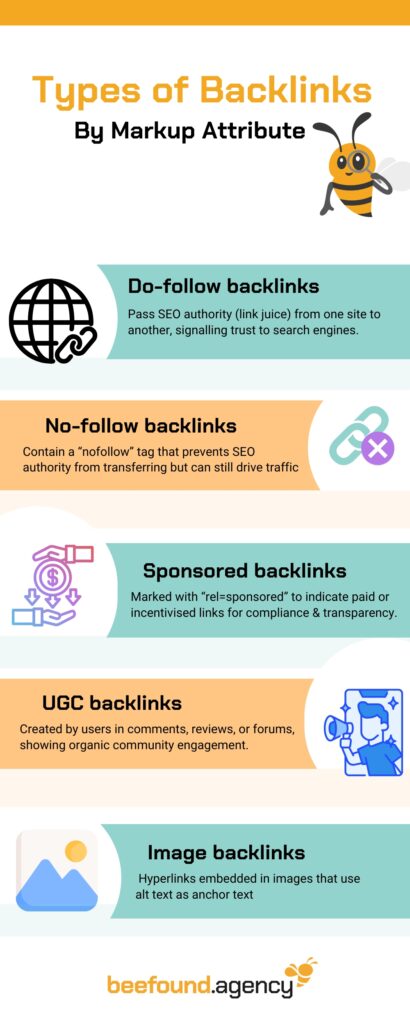
Backlinks by markup attributes
Here are the most common backlinks and how they’re marked up in HTML.
1. Do-follow backlinks
A do-follow backlink passes SEO authority from one page to another. This is often called link juice. These are the ‘bee’s knees’ of backlinks and the most valuable for boosting rankings because they signal to Google that a website genuinely endorses your content.
They essentially act as a vote of confidence, and when a reputable site links to yours with a do-follow, this tells Google your site should be ranking. Because of this, they’re fundamental to link-building campaigns.
An example of a do-follow link in HTML markup (more on markup later) would be <a href=”https://beefound.agency/> SEO agency</a>.
2. No-follow backlinks
A no-follow backlink tells search engines not to transfer SEO authority, and they include a “rel” attribute in the HTML code that looks more like <a href=https://beefound.agency/ rel=”nofollow”>SEO agency</a>.
While they might sound unnecessary on an SEO front, they’re actually essential – the reason being that many websites externally link with nofollow markup as a matter of course. As such, Google expects an organic mix of no- and dofollow links as part of a natural backlink profile, and – here’s the kicker – would treat an overwhelmingly follow-heavy inbound link profile as suspicious.
A good example of a no-follow backlink that does the business could be a link left in a professional forum on Reddit, relating to your business. If the comment includes a helpful resource link, it may be marked as no-follow because it’s user-generated. However, this link could still drive traffic to your website without traditional SEO value.
3. Sponsored links
Sponsored backlinks are generally paid for or exchanged for products or other incentives. They help keep your website compliant with Google’s guidelines and look like this: <a href=”https://beefound.agency/” rel=”sponsored”>digital marketing</a>.
Labelling them ensures full transparency and avoids penalties for attempting to manipulate the algorithms. They can also raise awareness and drive referral traffic, even if they aren’t as well-recognised as do-follow links.
Imagine a marketing agency collaborating with an influencer who writes a review of their services. If the influencer includes a paid link to the agency’s site marked rel=”sponsored”, it keeps everything above board, but still generates referral traffic and brand recognition.
4. UGC (user-generated content) links
UGC links are created by internet users instead of site owners, and can include customer reviews, comments, or forum posts. An example of this in HTML would be <a href=”https://beefound.agency/” rel=”ugc”>read more</a>.
UGC links show that links are community-driven instead of editorial, and the correct markup keeps your site trustworthy and protects it from unverified or spammy content. They can also signal brand credibility because people are engaging with your website.
5. Image backlinks
These are hyperlinks attached to images instead of text, and search engines use the image’s alt text as the anchor. An example would be <a href=”https://beefound.agency/”>
<img src=”logo.png” alt=”Beefound SEO agency”>
</a>.
These are fantastic for brand recognition, particularly if your website is in a visual industry, like design, hospitality, or retail. They’re also a big plus for accessibility and can help Google index your images properly.
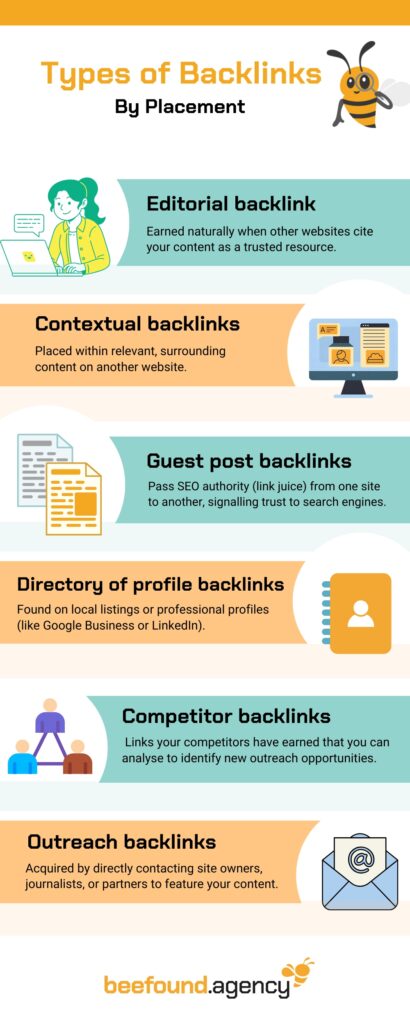
Backlinks by placement
Now we’ve covered how search engines interpret and treat your backlinks, let’s look at how they may appear in real-world situations, and some of the different types of backlinks out there.
1. Editorial and contextual backlinks
Editorial backlinks link naturally to your content when someone else finds it valuable and cites it. The best way to earn these is by writing using your expertise, which can take many forms, such as data-led resources, original research, or unique insights that others naturally want to cite.
Contextual backlinks appear naturally within the body of another page in amongst similarly related content. Since they’re found with relevant content, it gives search engines the nod that your site is also relevant.
Some contextual links are editorial, too, because they’re earned when other people cite your content voluntarily. Others may be strategically placed with guest posting or outreach.
2. Guest post backlinks
Guest post backlinks are links to your website embedded inside an article you wrote and published on another website as a guest author. Not only do they build relationships between you and others in your industry, but they also put you on the radar of new audiences. They can also be a great way to secure do-follow links if they’re placed on reputable websites.
The trick for strong guest post backlinks is well-written content that’s original and useful to the audience.
An example might be a SaaS founder writing a guest article for a respected tech publication, linking to a detailed resource on their own site that offers real value and explains the topic in more detail. Adding this link can boost SEO authority and introduce their expertise and the brand to more audiences.
3. Business directory and profile backlinks
Directory listings come from, you guessed it, online directories like Google Business Profile or Yell. Profile backlinks come from your accounts on professional sites like LinkedIn.
These verify the identity of your business and improve local SEO visibility while they’re at it. Even if they’re no-follow links, they can build trust, especially if your business details are the same across all listings.
4. Competitor and outreach backlinks
Competitor backlinks are the links your competitors have earned, which you can learn through SEO tools like Semrush. By analysing this information, you can find new opportunities for your own website.
Outreach backlinks come from contacting site owners, journalists, or other online partners, asking them to feature your website links. This is an example of value-led outreach, which is when you offer something unique and useful to relevant websites and audiences. The flipside of this would be cold outreach, which tends to be more random and scattered to as many sites as possible. This isn’t as effective and can harm your reputation.
Combining competitor and value-led outreach backlinks can help your SEO efforts by building real relationships and diversifying your backlink sources.
Which types of backlinks work best?
Do-follow backlinks are seen as the best for traditional SEO; however, balance is important when it comes to building backlinks. It’s also important to note that links that meet the following criteria deliver the best results, generally speaking:
- Come from relevant, high-authority domains
- Sit within editorial or contextual content
- Use natural, descriptive anchor text
- Are earned through trust and relationships, not automation
For most businesses, this means focusing on:
- Editorial mentions
- Guest posts on quality sites
- Digital PR and outreach
- Niche directories and citations
- Visual content like infographics or image credits
Targeting these types helps search engines view your website as credible and authentic, which can lead to higher rankings.
The role of AI search
We’re now in the era of AI and “zero-click” search, which has different ramifications for backlinks and the rest of your SEO practices.
AI-optimised content, for example, that LLMs (large language models) can parse, retrieve, and summarise, is becoming more and more important. Backlinks and consistent brand mentions are a big part of this as they help LLMs, like ChatGPT and Google’s AI Overview, identify trustworthy content to cite.
This means that websites with strong backlink profiles, clear internal linking, and cohesive content structures are more likely to appear as cited references in AI-generated results.
Strengthening your EEAT (Experience, Expertise, Authoritativeness, and Trustworthiness) through comprehensive topic clusters and well-linked content pillars can also boost your site’s topical authority. This can work wonders for visibility in both traditional and AI-powered search.
Keep your SEO on a roll
Now that you’ve deepened your understanding of the different types of backlinks and their importance in the SEO game, all that’s left is to put these learnings into practice. Keep the learning streak going by reading up on how to acquire your own backlinks on the rest of our blog, or take a look at our SEO services to see how the beefound.agency hive of professionals gets the job done for you.