Did you know that as many as 98% of consumers report that reviews play an active role in their decision-making process? This means reviews are a powerful weapon in your marketing arsenal – but let’s take that a step further: with Google Reviews being the public’s go-to review platform, and by a long shot, you ought to be exploiting its potential. Whether you’re advertising a bar, trying to steer your café’s brand reputation, or simply want to get a step ahead of your competitors, Google Reviews for restaurants can make all the difference in turning a casual online browser into a paying customer walking through your doors.
From the copious benefits of Google Reviews for restaurants and eateries all the way to strategic methods of improving your business’s online reputation, here’s an outline of everything we’re covering here. Feel free to skip ahead to the parts that are most relevant to you.
- What are Google Reviews?
- Their Role in Online Reputation Management
- Why They Matter for SEO
- How to Generate Positive Reviews
- Leveraging Google Reviews in Your Restaurant Marketing
- Conclusion
- FAQs
What are Google Reviews?
Google Reviews is the world’s most popular online review platform. A hub for user-generated testimonials and feedback about businesses, services or products, these reviews appear in a variety of places: the Google Maps pack, Google Business Profile listings and in the Search results when people search for specific businesses (see our tapas example below).
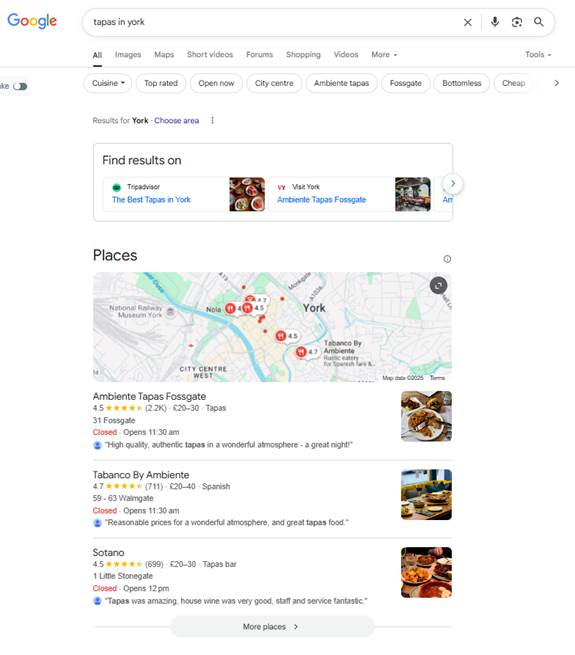
Google reviews can be up to 4,000 characters long, giving customers plenty of space to share detailed feedback. They typically include a star rating from 1 to 5, a written comment of the user’s experience, the reviewer’s name and profile image if available, the date of the review, and – crucial for restaurants, in particular – photos uploaded by the reviewer. Other users can mark reviews as helpful, and businesses have the option to respond publicly to the feedback they receive (more on that later…).
To get on Google Reviews, and indeed Google Maps, the process is fairly straightforward: all you have to do is claim or create a Google Business Profile, fill out your business details and have it verified. With this handy free listing, you’ll be able to generate a unique link to your review page that you can share with customers and, crucially, your restaurant will have a virtual hub that surfaces when people make relevant searches.
For more details on the step-by-step process, check out our tutorial on getting started on the platform.
Why Reviews are Crucial for Your Restaurant
If our explainer of Google Reviews was the starter, consider the following your apéritif – because this is where things get interesting.
Reviews on Google and beyond (think Yelp, Trustpilot, Tripadvisor, Just Eat and more ) are of growing importance to restaurants at all stages of their journey, from those just starting out to small businesses planning for strategic growth.
The reasons for this are twofold: reviews are an essential tool for online brand reputation management, and they can help propel your search engine optimisation (SEO) efforts to new heights. In other words, they not only influence how potential customers perceive your business, but also how easily they find it.
Let’s look at both sides of this coin in a little more detail.
The Role of Reviews in Online Reputation Management
In the hospitality industry, perception is everything, and today that perception is shaped largely by online reviews and climbing customer expectations. When diners are exploring their options, they’re after more than good grub – but an experience too. Therefore, your reviews should reflect the best of your service; from the variety of your menu, accessibility, cleanliness and value for money, down to intangible things like customer service and ambience. Here’s why reviews aren’t something to be scoffed at:
Make a Good First Impression
Reviews are often the first thing customers will see of your brand, whether that’s via a quick Google search for a related keyword or they’re scrolling through Google Maps on the go, trying to find a quick bite to eat. If you’re not in the running for these spots in the rankings (which, by the way are prime digital real estate) you may lose out on customers as your competitors snatch up 10 times the sales in the top 4 positions.
Furthermore, there is the role of positive rapport between you, the restaurant owner, and your customers. Demonstrating a positive dialogue between both parties, you signal to potential patrons that the business is genuine, active and cares about its clientele.
Social Proof
In a world where anyone can claim to be ‘the best in town’, reviews are how customers separate cold, hard facts from overblown marketing. Positive, and even constructive, feedback from real people goes a long way to build credibility and trust. Think of it as the digital version of word-of-mouth recommendations – except now its reach is incomparable since those personal experiences are visible to everyone, at any time.
Another thing to note is that consumers are placing all the more confidence in reviews they encounter online, with an ample 49% purporting to trust them as much as they do their friends. Therefore, for restaurants in particular, a handful of glowing comments can be enough to drive greater foot traffic to the venue. Social proof is no longer a nice-to-have; it’s a core pillar of customer decision-making.
Shape the Narrative
One of the most powerful aspects of reviews is that they allow you to guide the story being told about your business. While you can’t control what every customer says, you can control how you respond. Thoughtful, personalised replies to both praise and criticism show that you’re engaged and care about your customer experience.
Now, here’s a reassuring titbit from Google: customers actually find a mixture of positive and negative reviews more trustworthy than a 100% spotless profile. This helps build credibility, which in an industry as competitive as hospitality, is a great advantage. By actively managing reviews, you gain a say in the public discourse around your brand; and over time, this helps shape a narrative that aligns with your values, service and goals.
Filter Out the Competition
Good reviews can quite literally filter out the competition. As would-be patrons do their research, many narrow their search by star rating, only viewing businesses with 4 stars or higher. If your rating doesn’t make the cut, you’re out of the running before you even had a chance. So, maintaining a strong average rating ensures you stay in the conversation and continue to attract website visits, menu impressions and table bookings – and this means delivering great service consistently, even in the digital arena.

Why They Matter for SEO: 5 Benefits to Chew On
If you’re already familiar with SEO, you may have spotted it leaking into the Google Reviews benefits we’ve covered thus far. After all, digital PR and organic search are somewhat related. The more high-quality reviews you receive, the better your SEO performance. Here are a few of these benefits in a bit more detail:
1. Rank Higher In SERPs
Given that customer reviews directly support a business’s E-E-A-T (experience, expertise, authoritativeness and trustworthiness) – the values underpinning Google’s ranking system – the more well-written, accurate and positive ones you accrue, the better your chances of appearing prominently in Search. Relying on signals such as the quality, quantity, freshness and relevance of said reviews, it pays off to incorporate them into your wider promotional strategies, rather than treating them as a tick-box exercise.
2. Reach Local Audiences
Not only do reviews make a difference when SEO is concerned in a general sense, but they can be helpful on a local level too. According to the big shots at Google HQ, reviews are considered “a treasure trove of local knowledge” that assist users in discovering places and businesses they’ll enjoy. As such, their algorithm factors user-generated customer feedback into its evaluation.
Psst! Although we’re focussing on Google Reviews in this guide, remember that Google also likes to aggregate third-party reviews, and may even display snippets from other sources like Facebook and OpenTable. Often, you’ll see them shown under the “Reviews from the web” section in a Google Business Profile, alongside native Google reviews. The added bonus here is that the broader aggregated data contributes to your prominence, which is one of the core ranking factors for local search.
3. Increased Brand Awareness
One of the most important elements of customer reviews is brand awareness. Consistent, positive reviews, backlinks to your site and brand mentions across the web keep your business visible in search results and help it stick in people’s minds. Every new review is a small burst of content that adds to your overall online presence. Over time, this improves your restaurant’s discoverability not just on Google, but also across third-party review platforms like OpenTable and even social media. In short, the more people talk about you, the more others find out about you.
4. Appear In AI Overview
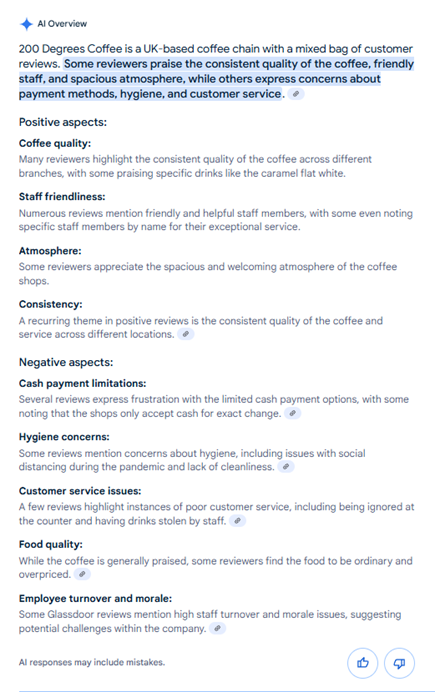
One of the more recent developments in the search engine world is how AI overviews are changing how we browse online and, by extension, consumer behaviour at large. While roughly 60% of searches yield no clicks at all – users satisfied with the AI-generated summaries served up to them – AI presents unique opportunities as well as challenges. As a consequence, your new goal should be getting recommended by both AI-powered search and large language models (LLMs) like ChatGPT, which is where reviews come into the picture.
As AI overviews pull from organic results, customer reviews are ripe ground for helping you rank. In the example below, you can see how they contribute to its understanding and presentation of your establishment – especially, if you’re lacking long-form content or PR pieces.
5. Give Your Paid Ads a Boost
Remember what we said about the aggregated data Google collects from native reviews and third-party sources? Well, this information also goes towards your Google Ads in the form of Seller Ratings. Essentially, a mini star rating/review displayed alongside your ad, Google Seller Ratings inflate your click-through rates and help convert those hungry customers. One last thing: if you connect your Google Business Profile to your Google Ads account, you can optimise your paid media even further – making your ads relevant for location-based searches by incorporating your business address and opening times. It’s all about making the decision-making process as easy as possible for diners.
How to Generate Positive Reviews
As the old Geordie adage goes, ‘shy bairns get nowt’. Translation: if you don’t ask, you don’t get. And this is very true of customer reviews. While some business owners are hesitant to ask, those who do are sometimes rewarded with thoughtful feedback, constructive criticism and praise. Of course, don’t ask them when they’re in the middle of their meal, but a few warm words as they pay the bill can be very effective. For more ideas, keep reading.
Provide Service Worth Shouting About
Great reviews begin with a great experience. When you offer consistently stellar service, delicious food and an Instagrammable atmosphere, people are far more likely to leave positive feedback and share photos. One simple way to encourage more personal, detailed reviews is to have your team wear name badges – guests often love to shout out individual staff members when they’ve had standout service, and that kind of recognition can make your reviews even more impactful.
Make It Easy (The Path of Least Resistance)
A well-timed, polite prompt can work wonders when it comes to encouraging reviews. Whether it’s a friendly mention from staff as guests settle the bill, a follow-up email after dining, or a simple text message, a gentle nudge helps keep your restaurant top of mind. You can also add subtle visual cues like a window sticker, a note on the receipt, or a QR code on the menu that links directly to your Google review page. The easier and more convenient you make it, the more likely happy customers are to share their experience.
Prime Your Business Profile for Ranking
Simply being online isn’t enough. Today’s era of digital marketing demands food establishments of all types to be discoverable online, and this means optimising your site and business listings across the web.
With your Google Business Profile, ensure each field is fully optimised, complete with updated hours, menus, high-quality photos and booking integrations. The easier it is to find and book your restaurant, the more likely you are to get traffic – and reviews! More reviews = more visibility = more bookings = even more reviews. It’s the kind of feedback loop every restaurant should aim for. For the full scoop, check out our guide to Google Business Profile optimisation.

Leveraging Google Reviews for Restaurants in Your Wider Strategy
Once you’ve got the reviews rolling in, the next step is knowing how to use them to their fullest potential. Beyond just collecting testimonials, reviews should be treated as a dynamic marketing asset that reinforces every part of your restaurant’s digital presence. From social media content to menu design decisions, Google restaurant reviews can, and should, play a role in how you present your business.
Universal Best Practices
Make it a habit to regularly monitor your reviews; not just to track public perception, but to gather valuable customer insights. Google Reviews act as a real-time market research tool for restaurants, offering direct access to the thoughts, preferences and pain points of your target audience. By compiling feedback, you can identify patterns around what your customers love (and what they don’t), giving you the chance to refine your menu, adjust your branding, or tweak your service to better align with diner expectations.
Engaging with reviews is equally important. Promptly responding to both positive and negative feedback shows your business is attentive and invested in customer satisfaction. These replies, when done professionally and personally, send a powerful message to potential customers: that your restaurant values people, not just transactions. Even negative reviews present an opportunity to win back trust and demonstrate transparency. If you’re not sure how best to approach tricky situations, we’ve covered best practices in our guide to responding to negative reviews. Done well, review engagement strengthens your brand’s credibility and earns you new customers.
Lastly, don’t let strong reviews go to waste – reuse them. With the reviewer’s consent, you can feature positive testimonials across your website, social media, paid ads and email marketing. These quotes act as social proof, reinforcing your brand promise through the words of real customers. Just make sure your approach stays within Google’s guidelines; offering incentives or bulk soliciting reviews can backfire. For more on what’s allowed, consult Google’s official user review policy.
Wrapping Up on Google Reviews for Restaurants
Long story short, Google Reviews – along with a smorgasbord of other influential review sites like Trustpilot and Yelp – can work wonders for your restaurant’s online reputation, if you use them well.
This means keeping tabs on what people are posting, trying out the SEO strategies we shared earlier, appropriately replying to both positive and negative reviews, plus reusing them in your wider marketing activities.
The most crucial ingredient, though, is listening to what your customers have to say and finding opportunities to genuinely connect with them. And, besides, you might not have the bandwidth to deal with the technical stuff in-house. If that’s you, it might be the case that you need a professional on board. Wink wink, nudge nudge.
Ready to polish up your online presence? Then you’re in the right place – beefound’s SEM specialists are eager to help your reputation sparkle in Search. Let’s chat.