If you’ve ever asked yourself “What is link acquisition?”, your mind is in the right place. This easily implemented strategy shouldn’t be overlooked. Why, you ask?
Well, it all goes back to improved search engine rankings, increased traffic and more eyeballs on your website. And gaining backlinks is more cost-effective and easier to accomplish than ever before. All you need is a website, an email address and a working knowledge of the best practices. But between strategy and outreach, it still takes an effort.
Believe me, at WebHummel, we’re working towards acquiring links for our clients day in, day out. This means celebrating our wins and continually polishing up our strategy. Below, we shed light on how link acquisition works, what it’s all about and how to do it yourself.
What is link acquisition?
Link acquisition is a helpful tactic for those looking to drive more traffic to their website where it can be converted into warm leads and/or purchases.
The strategy involves encouraging other websites to link to your own via a cocktail of different methods. This includes making your content something people will naturally want to share as well as reaching out to domain owners directly with a tailored pitch.
Sometimes you will hear this process being called ‘backlink building’; this is because the main objective is building up a pool of high-quality backlinks from authoritative websites.
The power of backlinks
Backlinks? Never heard of them.
If that sounds like you or someone you work with, it’s time for some rapid-fire learning. But, don’t worry, backlinks are really easy to get your head around.
We all know about links in general, right? Those long strings of text following the “https://” in our search bars or the highlighted text that, when clicked, takes us to another place on the web.
Well, backlinks are the links on other websites that go to yours. Sometimes these are called ‘inbound’ or ‘incoming links’ because they come in from external domains. Pretty simple!
How they boost rankings
We’ll let you into a little secret: the internet is run on backlinks. To explain, backlinks are one of the values (or ‘metrics’ if you want to be fancy) that Google uses to choose and organise which content appears in the search engine results page (SERP) for different queries.
Basically, Google runs an algorithm called PageRank that looks at web pages and how they’re all linked up. Without it, it’d be near-impossible to navigate the billions of results circulating the internet.
Google sees pages that have more incoming links from reputable and relevant domains as more valuable. This is under the assumption that people link to your content on their sites because they believe it adds value, is trustworthy and is relevant to their own audience – this trio being signals the internet giant considers in its calculations.
Of course, there are ways to abuse this system (ever seen random dodgy links on a forum thread?), but for the most part, the algorithm is able to tell when individuals are trying to manipulate the system and penalises them accordingly. This is why there are certain stipulations concerning how and where you get your links from.

So, what makes a good link?
While backlinks remain tied to 40% of the top 20 ranking factors, you can’t go adding links to your site from other domains willy-nilly. As we just mentioned, it’s important to remember that certain linking practices will be penalised by the algorithm – these behaviours are considered spammy and fall under what SEO natives call “black hat technique”.
To avoid these consequences the links that you acquire should be:
Relevant
While gaining backlinks from relevant sites can give your ranking signals a nice boost, remember that it’s also an opportunity to get real people on your site, preferably those with an interest in your offering. This means choosing sites whose audience base aligns with your own.
Do your homework and find sites that cater to your audience or a specific audience segment, and get ready to serve up a link to one of your web pages that will best suit their needs and desires.
Also, note that different websites have varying policies as to which topics they discuss and will link to, for example, a family-oriented blog is unlikely to accept content about gambling and drugs. Equally, a B2B-oriented blog centring on thought-leadership content probably won’t be interested in gardening or DIY content.
Contextual
As well as being relevant on a domain level, your links should be contextually relevant on any given page down to the sentence level.
Think of it like this: if you saw some linked text that said “affordable home décor tips”, you would assume that clicking it would take you to a tutorial, not a product page about dog food. You’d be confused, wouldn’t you? Anyone would.
And that’s part of the danger of not carefully considering your anchor text. Baffled users would instantly close it, the speedy rates at which they “bounce” from the page signalling to Google that it’s irrelevant. Which may then go on to negatively impact your rankings.
Authoritative
In the SEO world, there’s an important metric called Domain Authority (DA). It’s a metric that measures how likely a domain is to rank in the SERPs compared to its competitors on a scale of 1-100.
Though not an official Google ranking factor, DA is still valuable for identifying potential sites for link building and for tracking your own site’s progress because it is based on the quantity and quality of backlinks.
What counts as a ‘good’ domain authority will vary between industries, but you can get a good look at what competitors are doing and link to truly reputable sites that will pass on some of their value to your own.
Authentic
You also want backlinks that come from unique, genuine sites that create meaningful human-driven content. People like people, not robots. So make sure you engage with sites that are both well-established and original. This means that the page that your link sits on will be more likely to rank and garner more traffic whilst demonstrating to search engines that real people are finding value in your offering.
Well-placed
The placement of backlinks has some bearing on how well they perform and the stream of traffic entering your site.
For instance, it’s a good idea to place the link near the top of a web page, so those that skip through or don’t read the full content don’t miss it. Other good practices include:
- Writing descriptive linked text rather than pasting in a raw URL
- Building in a call to action
- Including keywords in the linked text
- Keeping the link a reasonable length
- Incorporating the backlink naturally into the content

Types of link acquisition: backlink building strategies
With the basics of backlinks covered, it’s time to dig deeper into link acquisition. Here are the main backlinking methods that we SEO experts swear by.
1) Organic
This one is very simple, but often overlooked. The better your content is in general, the more likely people are going to link to it on their own sites.
To achieve this, it’s a good idea to conduct an SEO audit of your pages to see where you can improve. This is because people tend to link to content and resources at the top of the SERPs, so the better you do there, the easier it will be to encourage others to share.
Another natural way to get sites to link to you is by trying out the skyscraper technique, coined by Brian Dean of Backlinko. Essentially, this involves looking at competitors and seeing how their popular content is performing, then using these insights to create your own original resource that achieves the same purpose – except, yours is better.
2) Broken links
This method really benefits from having a link building tool such as SEMrush at the ready, but you can do it manually too.
In a nutshell, broken link building involves finding broken or dead links and replacing the 404 error pages with working links to your own content. It goes like this:
- You spot a broken URL on a web page you’re interested in placing a backlink
- Find the owner of the site / editorial team / admin
- Reach out with a friendly email letting them know of the error on their page while offering a replacement for the broken link
- Wait for their response!
Interested? Here’s a handy free tool and Chrome extension that will trawl through all of those links for you!
3) Unlinked mentions
Acquiring links through references to your business on others’ sites is a tried and tested way of gaining backlinks for free. After all, if a website is already mentioning you in some capacity, they’re likely to be fans already. Just consider it as half the job done.
Whether you find a brand, product, content or personal mention, simply, reach out to the site owner and ask whether they’d be happy to add a link to the text referring to you. Obviously, don’t waste time on this strategy if it’s a negative reference or if the site is spammy / suspicious in nature.
4) Guest posts
Guest posts are the bread and butter of backlink building. This method is all about crafting articles containing your chosen link and getting them hosted on other websites.
These types of posts may be ghostwritten, but more often than not, guest articles will contain a disclaimer (usually at the top) that lets the reader know they are sponsored content or created in collaboration.
In tandem with these disclaimers, the backlink itself will be marked as “sponsored” in the HTML markup, meaning that Google will know not to penalise it as link spam.
Top tip: While AI content can rank, we strongly encourage that you stay clear from using it as your sole writing method. By all means, use it to enhance your writing or to supplement your research. But, remember, AI is flawed and can interlace inaccuracies and sloppy writing techniques.
5) Digital PR
This practice’s main aim is to raise awareness and build credibility around your brand. Digital public relations (PR) is similar to traditional PR in the sense that it works to bolster a positive public image via a range of communication channels such as magazines, newsletters, news sites, events and sponsorship platforms. The only difference is that it takes place in the online arena.
Depending on your business niche, it may take on a different style from formal thought-leadership content to informal and friendly podcast discussions.
To give you an example, WebHummel featured in York’s local press as the company celebrated its 5th year of business. Here, we were able to improve our visibility and enhance our reputation.
6) Directory listings
Directory listings technically come under UGC links. UGC = user generated content. So these types of links are created by users.
Acquiring directory listings is fairly simple. The process usually involves finding relevant and reputable online business directories with a good DA, reaching out to them with your information or filling in a sign-up form. We have an in-depth guide on the topic, so make sure you check that out.
7) Sharing valuable resources
When it comes to backlink acquisition, linkable assets are your friends. These might be studies, surveys, tools, infographics, video series, courses or just a damn good article. Some people call these types of resources “link bait” for self-explanatory reasons. An example, of what we’re talking about is WebHummel’s Google Seller Rating Checker.
8) Reclaiming lost links
Last but not least is the link reclamation technique. All you need to do here is find links that once sent traffic your way but have been broken or removed for some reason. You’ll find that a friendly email sent to the site owner with an updated link might just see the connection between sites patched up – just make sure you get the tone of your email right. Remember, we’re giving rewarding suggestions, not begging.
What does link acquisition look like in practice?
So, we’ve outlined the basics of the link acquisition process, but what does this actually look like in practice? Here’s how we do it as experienced off-page SEO specialists.
The tools we use
We use a variety of SEO tools but our main four are Asana, SEMrush, Mangool’s SiteProfiler and Bigin.
- Asana – for tracking the content creation workflow from briefing all the way to publication.
- SEMrush – for finding and monitoring prospects along with our acquired links.
- SiteProfiler – for checking the domain authority of prospect sites.
- Bigin – for storing data on prospects and tracking our pipeline.
Our process
WebHummel’s SEO outreach process has been well-documented on our blog, but this quick rundown should get you up to speed.
We start by curating a list of high-quality prospects with strong DA, using a combination of SEMrush’s link building tool and independent research.
Then we reach out to the site owner or editorial team and set reminders for a tailored follow-up if there’s no response. (You can automate this process if you wish.) Once we’ve made contact, we’ll start negotiations, discussing post guidelines and topics. Then we’ll get to work.
Example pitches
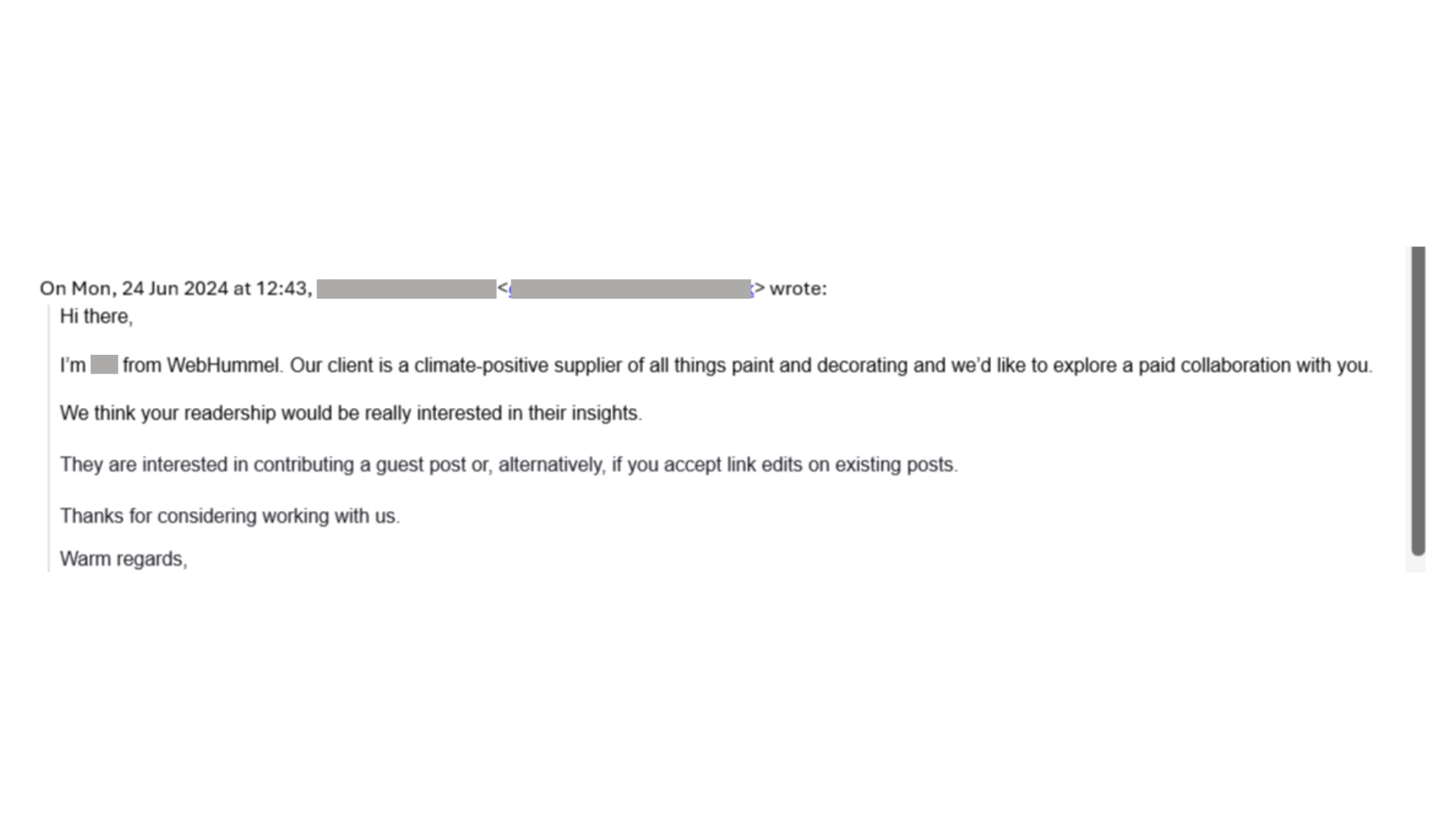
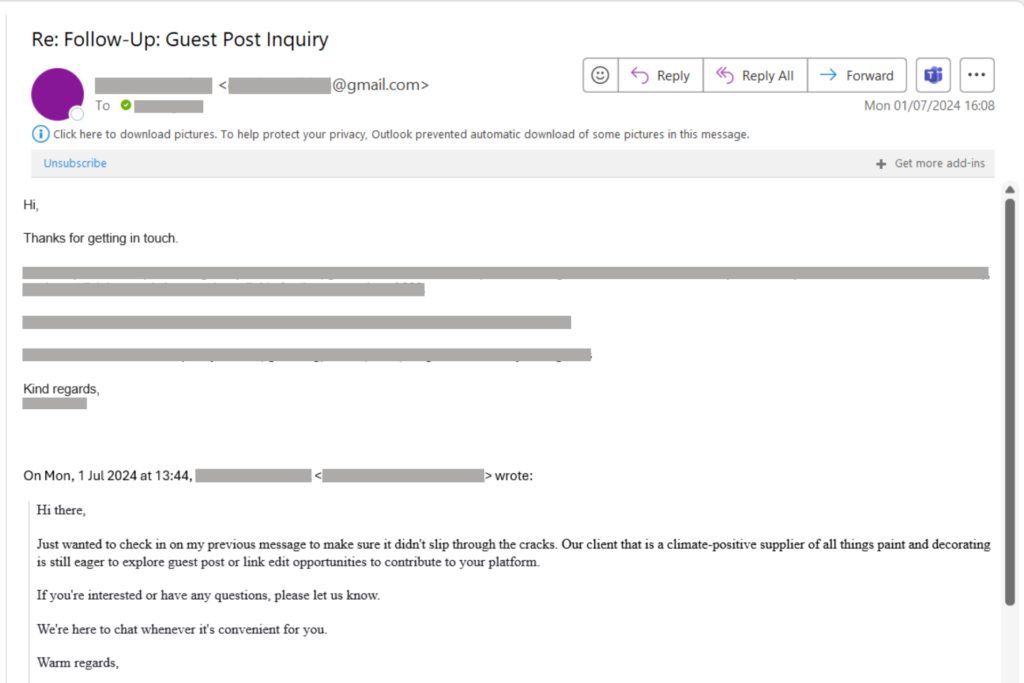
To give you an idea of how to best write your outreach emails, here are some examples from a successful campaign.
Below is our Outreach Assistant, getting in touch with a prospect
Here’s an example of a follow-up email
Link acquisition FAQs
How much time does backlink outreach take?
This can vary wildly depending on the type of outreach you conduct, the level of back and forth between you and other site owners and how long it takes you to create any content you want to be hosted or linked to.
As the quality of your backlinks is more important than the quantity, it might be a better strategy to spend more time really curating your backlink portfolio. And, if you have the time, conducting a few hours of outreach a week can be really beneficial.
Do I need to tailor each pitch/email?
Not necessarily, but the data shows that personalised emails have more chance of being read and genuinely considered. A key tip to note is that while your emails should be personalised, it doesn’t mean they need to be as long as an essay. Short and sweet, clear and friendly will do the trick.
Should I pay for backlinks?
This is a contentious subject, due to Google’s policy against ranking manipulation, but the general consensus is that buying backlinks is fine as long as you use link attributes / disclaimers clearly marking them as sponsored and you’re careful to only accept backlinks for reputable, well-established and high-quality domains.
Are backlink monitoring tools a requirement?
Not at all, but they’re a lifesaver if you have limited time for online detective work.
Can I outsource link building?
Of course! There are plenty of digital marketing agencies and freelancers who are very willing to take on this load. By outsourcing the work, you take a lot off your plate whilst benefitting from expert opinion and a suite of specialist tools included in the overall SEO costs.
The sky’s the limit
Getting to grips with link acquisition can feel like a lot at first, but with the right know-how, a streamlined strategy and a bit of hard graft, you’re bound to see positive results.
And if things don’t quite go to plan? It’s back to the drawing board with the data in hand to work out the areas where you can improve. Take things one step at a time and really do your homework, and you’ll see gradually take flight. We ‘bee-lieve’ in you!