If you’ve been lingering in the digital marketing space, want to learn the ways of PPC advertising, or simply heard of Google Discovery Ads on the grapevine, we salute you for your curiosity. After all, eager minds are one of the key ingredients to an adaptable, and most importantly, profitable business.
So, Discovery Ads – what are they? And what is all the fuss about?
Woah, wait up. Sorry to do this, but I’m going to have to pull the carpet from under your feet. Yep, that’s right, Google Discovery Ads have been consigned to the past. Back in 2023, Google announced that it was transitioning away from this form of online advertising for something new. Now, it’s all about Demand Gen – this bad boy has usurped the role of Discovery Ads and, strikingly, relies on AI-powered targeting to reach a mouthwatering 3 billion monthly active users across a plethora of popular platforms.
It’s fair to say that, if you want to level up your advertising game, you shouldn’t sleep on this powerful addition to the Google Ads network. Which is where WebHummel comes in. We ‘busy bees’ have been keeping tabs on digital trends, so you don’t have to, and have even pulled together this guide for plucky business owners aiming to make their mark on the digital landscape. Let’s roll on.
Skip to:
- What is Google Discover?
- The legacy of Google Discovery Ads
- Google Discovery Ads vs Demand Gen
- Everything you should know about Demand Gen advertising
- How to get started with Demand Gen
- Conclusion
First things first, what is Google Discover?
Think of Google Discover as a marketing channel uniquely tied up with users’ Google search behaviour. To put it simply, it’s a feed that appears on the homepage of the Google App that serves you up content based around your search history, interests and locality amongst other data insights. If you’re an Android user, it might even show up if you swipe right, depending on the device.
The interesting thing about Google Discover is that, compared with its regular search engine, which provides inbound content, it actively delivers information without you having to lift a finger. Before you put so much as a word into the search bar above, there’s already a nicely curated feed choc full of articles, videos and more, picked out algorithmically just for you.
Where can I find Google Discover?
Despite Google Discover’s powerful, raw marketing potential, not that many people are aware of it. So, if you’re not sure how to access the feed, no worries. Here’s a few ways to take a look at it:
- Open the Google App
- If you have an Android phone or tablet, navigate to your browser on google.com.
- On specific devices, swipe right from the home screen.
The legacy of Google Discovery Ads: What were they & what happened to them?
By the means of deduction, you’re probably privy to the fact that Google Discovery Ads were ads fed to Google Discover users. It’s in the name, right? Well, sad to say, these ads are no longer around.
But before you feel bad about it or wonder where on earth they disappeared to, know that they weren’t completely written off. Instead, Google transformed this type of Google Ad into something far more powerful.
To understand how exactly they were improved, let’s give you a quick overview of what Google Discover ads looked like back in the day.
How Google Discovery Ads worked
When Google Discovery Ads were at their height, they would pop up all over the place on Google’s products. They appeared on the Google Search Network and the Display Network too, encouraging users to engage with brands in a meaningful way that wasn’t directly focused on converting them into customers.
In the past, you could pay for them to appear in the Google Discover feed and, interestingly, in places like YouTube and Gmail, which were absolute game changers at the time. These ads were rich visuals-wise, optimised for mobiles and harnessed a suite of sophisticated analytics, using almost all of the targeting potential available with Display advertising.
The great phase-out: From Google Discovery Ads to Demand Gen campaigns
We already know the end to this story – Google Discovery Ads were replaced with Demand Gen campaigns – but how did we get from A to B? Well, back in June 2023, Google unveiled a new AI-powered tool by the name of Demand Gen. This handy feature was released to simplify how brands connect with their audiences and drive demand from the mid-stages of the buyer’s journey all the way to purchase.
Hot on the heels of this development, Google announced that it would be rebranding Discovery Ads to Demand Gen, making the reach of rich image and video assets in the Google Ad network broader and all the more targeted. This switch-up was rolled out globally and, now, the change is fully integrated.
Google Discovery Ads vs Demand Gen
Both types of ads use an outbound strategy to reach new audiences across the Google Discovery Feed, YouTube (including Shorts) and Gmail, relying on swish graphics that look and feel very similar to regular social media ad formats.
The key difference between these ads, however, lies in a few core elements that we’ll get into. But, in a few words, Demand Gen offers a handful of potent enhancements, which you can see in the infographic below.
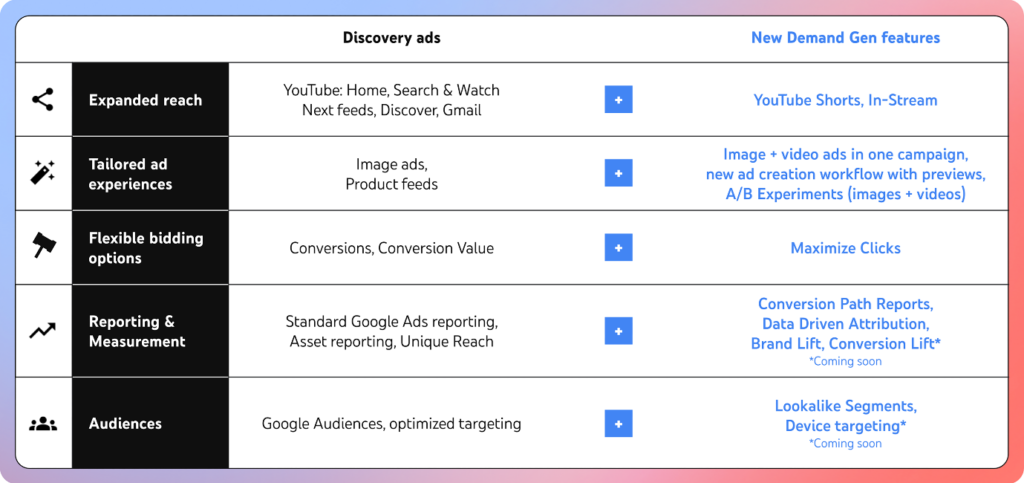
Credit: Google
Everything you need to know about Demand Gen advertising
We’ve covered how Demand Gen advertising has given Discovery Ads an upgrade, but is there anything else you ought to know? In this next section, we’ll go through its benefits, how the ads work and then blitz through the steps to get started.
Their implementation
This part is really exciting as the number of potential eyeballs on your ads is startling. With 5 key social touchpoints, you can convert future customers with what Google calls “immersive, relevant and visual creatives” – AKA your visually arresting ads – and these will be served up at just the right moment thanks to Demand Gen’s detailed analytics.
These touch points are as follows:
- Google Discover
- Gmail ads
- YouTube Shorts
- YouTube in-stream ads
- YouTube in-feed ads

The tangible benefits: 7 reasons to use Demand Gen
1. Snowball your reach
The most obvious advantage of using Demand Gen campaigns is its sheer reach. With access to the internet’s most popular, immersive and visual touchpoints, the potential for enhanced brand awareness is high and nurturing leads in this way will improve conversion rates further down the line or in other campaigns, both organic and paid.. Think of the 50 billion + global daily views on Shorts – that’s motivation in of itself!
2. Remarketing magic
Demand Gen is a popular advertising platform in the world of PPC, thanks to its affinity with retargeting campaigns. Pmax campaigns (a type of goal-oriented Google Ads campaign with access to your whole GAds inventory) deal with a lot of remarketing on the whole, but you can also remarket with videos and more socially engaging ads.
It works really well to recoup losses from abandoned baskets and nurture people still in the process of considering your business. Simply, retarget these would-be customers with further videos of the product, positive reviews of your service and social media-esque ads, and you’ll see a positive return.
3. Driving demand
It’s in the name – Demand Gen is all about driving demand, grabbing people’s attention and spurring them on to take your desired action. Because YouTube and Gmail are such social channels, you can take advantage of the versatility of Demand Gen’s placement / formats (video, carousel & display ads) for a truly engaging campaign.
4. Streamlined management
Since Google consolidated its ads network, it’s been easier than ever to achieve great heights with your PPC management. And if you’re an ecommerce specialist, listen to this: you can integrate the Google Merchant Centre with Demand Gen, meaning that you’re able to run product feed ads on YouTube, Gmail and Discover, nestling them in with their daily news.
5. Shiny new creative formats
Demand Gen prides itself on being audience-first, and its tailored ad experiences are the cream of the crop. From lookalike audience features that help you with market segmentation to the ability to A/B test with format previews, there’s plenty to play with. This way, finetuning your approach around different groups like those who made past purchases, visited your website or even viewed some of your YouTube vids is optimised to the max.
6. AI-fuelled analytics & bidding
One of the major hooks of Demand Gen advertising is its AI capabilities. Designed to streamline your entire funnel and keep your ad spend efficient, its roster of tools like brand and search lift is both intuitive and powerful. Here, you get the best audience insights, metrics and PPC bidding wrapped into one.
7. Enhanced impact
Ultimately, Demand Gen is all about maximising your performance across the search giant’s most immersive and entertaining platforms. It’s all about increasing clicks, conversions and, indeed, conversion value in a social-adjacent flow.
How to get started with Demand Gen
We don’t have enough time to get into the meat of setting up a Demand Gen campaign, but here’s a quick overview for those interested in giving it a go.
Then, bam, you’re done! Run your campaign and keep checking in for updates on performance analytics, so you can tweak your strategy if necessary.
Make the most of Google’s advertising suite
By now, it should be clear that Google’s advertising suite is a goldmine for growing businesses looking to get their name out there. Here, Demand Gen is just the beginning.
As Google has attested, marketers today are doing more with less, and Demand Gen’s toolkit is designed to help you do just that. Its sleek AI-powered solutions are ready to streamline your experience and put smart decision-making at the heart of your campaigns. The only question left is, are you ready?
And so, here’s where we part ways – unless you’re still thirsty for Google Ads insights. In that case, you might want to stick around on our digital marketing blog to learn more. Or perhaps, if you’re short on time or resources, you could give us a ‘buzz’to chat about how our PPC services can help you.