Charities in the UK’s third sector and beyond are facing the same challenges as any other business, right now. A cost of living crisis combined with an increasingly competitive market makes staying afloat more difficult than ever.
Quality charity SEO, however, can maximise your non-profit’s visibility, putting you in front of the right kind of potential donors at the right time.
We put together our ‘hive minds’ to come up with this no-nonsense guide to SEO for charities – walking you through the definition and applications of SEO in a third-sector context, before delving into some of the best practices you can begin employing today, regardless of budget.
Contents
- Introducing SEO: The Beginner’s Guide
- 5 Benefits of Charity SEO: What a solid SEO plan can do for non-profits
- Charity SEO Best Practices for Non-Profits on a Tight Budget: 6 Tips from Beefound.Agency
- Conclusion: Recapping the Benefits of SEO for Charities

Introducing SEO: The Beginner’s Guide
SEO stands for ‘Search Engine Optimisation’. It refers to the practice of auditing your website and optimising your digital presence, so as to give your charity the best possible chance of ranking highly on search engine results pages (SERPs) for a wide range of relevant search terms.
In short, SEO is how you, as a non-profit, get found on the internet by potential donors, and how you convert those donors from potential to active.
As the internet evolves, so too do the rules and processes governing quality SEO. Google – the leading internet search engine – leads the way in SEO, dictating an ever-changing formula by which we can help it find and display our website pages to relevant users. This formula can be broken down into three key areas: technical, on-page, and off-page.
Technical SEO
Technical SEO for charities is the stuff happening behind the scenes. This can encompass the coding of your website, its internal links and their functionality, as well as the load speeds of your various pages. It’s all very well optimising the visible webpage for a visitor, but if it loads slowly and is indexed poorly (the technical stuff!), then chances are the visitor will never find your page in the first place, or won’t stick around long enough to engage with your content.
On-page SEO
On-page SEO is what you use to make sure the content you are producing for your non-profit’s website looks, feels, and reads as smoothly as possible. It’s all about formatting your pages consistently and clearly, to ease user navigation, whilst providing information in an authoritative and original way, which both the user and Google can easily tell is useful.
Off-page SEO
Finally, off-page SEO is the work you put in on other people’s, and other organisation’s websites. It is comparable to the digital era’s version of networking at a conference. Off-page SEO for charities can involve guest blogging for sites which share your target readership, to show your charity’s authority on the subject; or it could include making connections with companies willing to backlink from their website to yours, thus directing more traffic your way.
5 Benefits of Charity SEO: What a solid SEO plan can do for non-profits
We understand that the thought of learning a whole new field of complicated-sounding digital practices is not always appealing, especially to people as busy as those working in the charity sector. But SEO is more than worth the time it takes to get to grips with it. Here’s a quick look at just some of the ways investing in SEO for charities can benefit the organisation as a whole.
1) Remain competitive in your charity niche
The internet is awash with hundreds of millions of pages each fighting for the spotlight, often in the same niche. SEO is the set of practices which enable small businesses and non-profits to reach a specific demographic amidst the noise and competition.
With the right keywords and content (as we’ll come to in a moment), your charity can establish a digital presence true to itself, and which is much more easily discoverable than if you’d continued competing directly with bigger brands.
2) Reaching more of the right kind of donors
The goal of any SEO campaign is ultimately to increase the quality and quantity of traffic to your website. For charities and non-profits in the third sector, the goal is to ensure that this traffic is as full as possible of people likely to be concerned with your cause, and able to support it. Whether you wish to raise awareness of the issue you’re raising funds for, or raise those funds directly, SEO for charities puts your name in front of the right donors, more of the time.
3) Increasing brand awareness among the public
The journey to becoming a charity donor begins with brand and issue awareness, which is another area SEO can greatly help with. According to one recent survey, the average small charity relies on the public for more than half of its entire funding.
Crucially, then, you want your cause to be seen and understood by that same public. SEO helps to ensure that however complex your charity’s field or work may be, it can be made digestible and engaging to the average reader.
4) Garner local attention for local events, shops, and fundraisers
The demand for local charity shops is on the rise, as life becomes more expensive and wages stagnate. Charity SEO is a necessity for any charity with a local presence, as it ensures that potential customers searching for ways to support your cause locally, know where to find you.
On the flip side, Search Engine Optimisation also helps you to limit the amount of irrelevant traffic your site receives. If, for example, you operate a pet rescue centre in Inverness, Scotland, it would be of no use to you to be receiving traffic from London, England, or even Glasgow, Scotland, let alone further afield.
5) Improve your relationships with new and existing supporters
We could go on, but one final major benefit to SEO for charities we’d like to touch on is how it helps you to foster and maintain healthy relationships with your supporters. Combining technical and on-page SEO practices, you’re able to craft a ‘user experience’ (UX), ‘interface’ (UI), and user journey which is stress-free, straightforward, and rewarding. Doing so improves the chances that visitors to your site will become donors, and that active donors will remain supporters for longer.

Charity SEO Best Practices for Non-Profits on a Tight Budget: 6 Tips from WebHummel
SEO can be time-consuming, but it doesn’t have to be costly. In fact, some of the very best SEO practices are entirely free to implement. For charities and non-profits with a tight budget (and equally for those without), here are 6 tips from the WebHummel ‘Queen Bee’ of SEO for small businesses and charities.
Tip 1: Get to know your keywords
A great entry point for anyone new to SEO, keywords are key to ranking highly on SERPs. Keywords are terms which people commonly use when asking a search engine something. For charities, these keywords will be pertinent to your specific cause. A simple yet extremely effective SEO practice is to research the keywords most relevant, and local, to your organisation, and then use them when creating content for your site.
You can buy keyword research tools which automatically sift through search terms to find those most relevant and popular to your niche, or you can conduct your own research for free. To do so, first think about the kind of questions people may be asking of your niche. For example, if you run a charity for childhood meningitis, you could capitalise on such keyword terms as:
- What is meningitis?
- What is childhood meningitis?
- Can children get meningitis?
- Is there a cure for meningitis?
- What are the symptoms of meningitis in children?
By then Googling these terms yourself, you can discover other relevant terms in the “People also ask…” section, and the “Related searches” section at the bottom of the SERP.
Armed with your relevant localised keywords, you can use them when creating articles, blogs, newsletters and website copy – where relevant – to attract the attention of Google’s algorithm.
Tip 2: Create the content you’d want to read
When drafting a new piece of content for your charity website, ask yourself why it is necessary and how you’re going to make it stand out from the crowd. Google dislikes content which merely parrots existing pages on the internet. For yours to rank, it must be well-written, accessible to the mean user’s knowledge and reading ability, authoritative, engaging and, most importantly, 100% original.
- Length: Short pages tell Google one thing and one thing only: there is not enough information present for the page to be either an authority on its subject, or of much use to the end user. Whilst it equally dislikes pages filled with fluff, to rank as an authoritative site on your charity’s central issue, you must create content long and detailed enough to prove your expertise.
- Language: Jargon, though often used among people in the same industry (AKA “business speak”) is not your friend when applying SEO. Your goal is to translate your work, your message and your aims to people who may be entirely unfamiliar with the topic. As such, it’s best to use accessible and digestible language, shorter sentences, and a clear, active tone.
- Format: Long, unbroken screeds of text have the effect of putting even the most seasoned readers off. Instead, format your content to be as easy on the eyes as possible: breaking up long paragraphs; adding images; bullet point lists; and dividing the text into headings and subheadings.
- Originality: Don’t plagiarise. Plain and simple. You can use other sites for inspiration and primary research, but the final content must be unique and original. AI textbots might know which keywords to use, but their content all ends up sounding the same.
Tip 3: Tidy things up behind-the-scenes
We touched on technical SEO earlier, and this is where it comes in. Metadata is a term referring to the code which informs the structure and character of your website.
A meta title, for example, is the blue hyperlinked title of your page which will appear on SERPs. A meta description is the block of <155 characters which appears below the meta title, enticing the web browsing user to click on your link rather than someone else’s. Headings (H1, H2, H3) which we touched on in the ‘Format’ section above, are also metadata. The tags and categories you use when indexing each post/page are yet another form of metadata.
Similarly, when inserting images into your content, it’s good practice to accompany them with something called ‘alt text’ or ‘alt tags’ – metadata which you can edit in the page- and post-creation interfaces of your website host (WordPress, for example). This text describes what the image contains to ensure that it remains accessible to all, including those with visual impairments – a must for all sectors, especially charities.
Keep your metadata consistent, relevant to your charity niche, and structured around the right keywords for the right page. Doing so makes it easier for Google to find your site, understand what it’s about and how it’s structured, and thus determine which of its users to show it to.
Tip 4: Make friends with the other ‘busy bees’ in your hive
This tip is all about off-page SEO for charities. Charities have always existed on the strength of community outreach and donor connections; in the digital age, this hasn’t much changed. You can drastically increase the traffic to your site by piggybacking on the audiences engaged by others.
Get your information (including your website) listed in local, relevant directories commonly used by internet users. Conduct business outreach to other similar organisations, as well as those whom a partnership with your charity could mutually benefit (i.e. a clean water charity contacting a start-up designing sustainable water filters) – then ask these groups to link to your website from theirs. You could also reach out to relevant blogs and ask to write a piece for them, in which you include similar backlinks, or invite other writers to guest on your blog.
Any off-page SEO you can conduct expands the potential pool of donors your charity may be exposed to.
Tip 5: Craft the user’s journey
We also touched on UX and UI earlier. Unfortunately, internet users today are fickle beasts. If they feel their experience on your site was negative – pages loaded too slowly, too much text and not enough images, they didn’t know where to find the information they were looking for, etc. – then no matter how important your cause, you may lose their interest in donating to it.
Charities which are competent at SEO for user experience and interface know that a smooth, easy and enjoyable experience directly equates to a higher conversion rate. Take this example from the homepage of Save the Children UK.
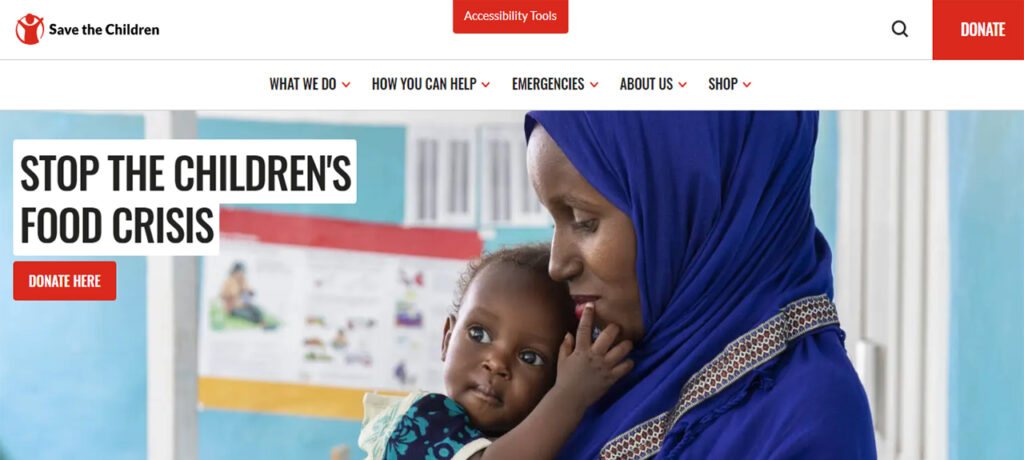
Immediately, we are presented with a few key SEO features:
- Save the Children’s branding is clearly visible, and tied into the rest of the page with colour.
- The header menu isn’t clogged with a million options, but instead has five self-explanatory buttons to choose from.
- There are two big, bold CTA (call to action) buttons urging visitors to the site to ‘Donate’ – this is the conversion goal of the charity and they have recognised that these buttons need to be visible and available from the beginning of the user’s journey.
- An image has been used to give the user a clear focal point, whilst preventing them becoming inundated with text-based information.
- ‘Accessibility Tools’ are available front and centre, ensuring that the site is immediately accessible to all, regardless of their additional needs.
Tip 6: Compliment your SEO with other marketing strategies
The digital presence of a charity or non-profit should go far beyond their website, and the SEO implemented there. To truly capitalise on all of the hard work and time you’ve invested in your charity SEO, you need to combine and complement it with a range of other effective digital marketing strategies. Two key additional strategies are:
Social media marketing:
Similar to content marketing, social media marketing involves engaging new audiences via the social media platforms they prefer to use. With different demographics trending toward different apps, combing a Twitter presence with profiles on Instagram, TikTok, Facebook and YouTube significantly increases the audience you can reach. You can then use the content you post on your socials to redirect traffic back to your website or eCommerce store: the sites they will use to become donors and supporters.
Pay-per-click advertising:
A form of advertising by which you bid to display your website for specific keyword search terms, and only pay for the ad when it’s engaged with. A seriously effective budget-conscious means of ensuring your page ranks highly for the most important keywords in your sector.
Conclusion: Recapping the Benefits of SEO for Charities
Big or small, your non-profit deserves its share of the limelight. If you want to increase the public’s awareness of you and your cause, whilst improving the quality and quantity of traffic to your site(s), then investing in quality charity SEO is key.
There is much you can do on your own, for free, with just a little research – and this can go a long way to building a solid foundation of donor support.
Of course, not every organisation has the resources to dedicate adequate time to SEO. Equally, they may be missing a few crucial SEO elements, which is prohibiting them from achieving their potential.
To learn more about boutique, professional SEO services tailored to charities and non-profits, speak to beefound.agency today.